Hello, everyone! My regular readers know how much I love experiments. I love using new tools or materials. I also really like finding new tatting weaving techniques. When I create my patterns, I always try to make them original, understandable and usable. But I love it when my customers make their own changes and additions to my work. Ah, I keep repeating: creativity is welcome!
My model of earrings is called Snow. These are the white earrings in the photo. And the second photo was kindly provided by Christy. I am delighted with her version! The beads and the color of the threads are reminiscent of the glittering drops of melting snow on the first spring flowers, isn’t it?
And in these photos my 3D Bow pattern and a completely unexpected version of Christy . She combined two bows into an original brooch, bravo!
When I was creating the Mandala doily pattern, I could not even imagine that it could be a wonderful dream catcher! Look at the beauty of Dawn!
Finally, my favorite collar is Sea Glass. Elena made her own version, complementing the collar with large beads and small details along the edge of the collar. It is amazing!
Of course, I can talk about my customers endlessly! These are extraordinarily lovely ladies and very talented tatting masters. But I hasten to tell you about my new video. The topic of the video tutorial is how to make a ring on a chain. And, naturally, I tried to show my creativity and shot 5 ways.
Method 1.
This is the traditional way for two shuttles. In my opinion, in this case, the ring on the chain look perfect.
Method 2.
You can try this motif with one shuttle and one ball. Of course it will look like a chain-ring-chain. But why not?
Method 3.
And this method is for tatting with a needle. I think you will like it. So, if you do not knot after half of the chain and after the ring, it almost looks like a classic ring on a chain. Do you agree?
Method 4.
In this method I used knots and it is very similar to method 2 for the shuttle. But you do not have to cut the thread and change the needle. Of course, this method has its pros and cons!
Method 5.
And this method looks perfect, in my opinion. You can use two needles. By the way, do not forget that both needles must be the same thickness. But you can do this with just one needle. Of course, in this case, after the first half of the chain, pull the thread out of the needle, then weave a ring on this needle. Then pull the thread out of the needle again and weave the other half of the chain. Sounds complicated? It’s actually very simple, you should try it! I say: don’t be afraid to experiment!
How to read tatting patterns, or how I write my tatting tutorials
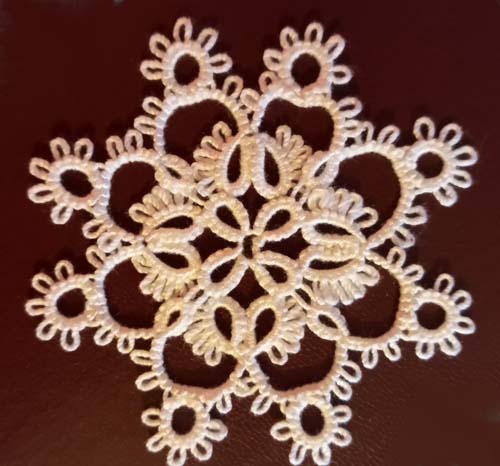
Hello everyone! I recently received an email asking me to help my FB friend learn to read tatting patterns. Oh, this is a very broad topic! Of course, I’ll try not to tire you too much! But I have prepared several versions of instructions that are in the books on tatting by different authors. So, the diagram we are going to look at today is very simple. I created this snowflake specifically for this post.
How to read tatting patterns
Before we start weaving, let’s take a look at a few example instructions. Of course, before starting work, you must carefully learn the Abbreviation. Some terms may differ from another author, but the basic elements are always the same. These are Ring, Chain and Picot. I am not covering more complex elements in this pattern. I will not name the authors who I took as templates for writing instructions for ethical reasons. You will need: two shuttles or a tatting needle, white thread # 10, a crochet hook, scissors and a good mood!
Example 1.
Abbreviation: Number = number of double stitches between the picots, R = ring, C = chain, + = joining, 1 X 4 = 1 – 1 – 1 – 1, 2 X 6 = 2 – 2 – 2 – 2 – 2 – 2, – = picot Number of shuttles: One, and second thread Row 1 Shuttle 1: R: 5 – 2 – 2 – 2 – 5. Repeat 3 times.
I really like these instructions for their brevity. But I think you will agree with me that it is too difficult for beginner tatters. You may ask: where does the work start, when to turn the work? This is where the difficulty lies.
✼ R: 2 – 1 – 1 – 1 – 1 – 2 + ( to Ring of Row 1) 6 – 2 cl DNR R: 2 + ( to previous Ring) 6 + ( to next Ring of Row 1 ) 2 – 1 – 1 – 1 – 1 – 2 cl rv Ch: 3 – 2 – 2 – 2 DNR R: 2 + ( to previous Chain ) 2 – 2 – 2 – 2 – 2 – 2 – 2 cl DNR Ch: 2 + ( to previous Ring ) 2 – 2 – 3 rv R: 5 + ( to Ring of Row 1 )5 cl rv Ch: 3 – 2 – 2 – 2 DNR R: 2 + ( to previous Chain ) 2 – 2 – 2 – 2 – 2 – 2 – 2 cl DNR Ch: 2 + ( to previous Ring ) 2 – 2 – 3 rv Repeat from ✼ 3 times.
In my opinion, there is no need to write “close” at the end of each Ring. After all, we see at the beginning of the combination that we need to make a ring. Thus, this Ring will be closed anyway. Perhaps you know of any cases where the ring is not closed? But will this element then be called a ring? However, these instructions indicate at the end of each element whether or not to reverse the work. This is a plus, no doubt.
✼ R: 2 ds, p, [1ds, p] 4 times, 2ds, jp to Ring of Row 1, 6 ds, p, 2ds, cl R: 2ds, jp to previous Ring, 6ds, jp to next Ring of Row 1, 2 ds, p, [1ds, p] 4 times, 2ds, cl C: 3ds, p, [2 ds, p] 2 times, 2ds R: 2ds, jp to previous Chain, [2ds, p] 6 times, 2ds, cl C: 2ds, jp to previous Ring , 2ds, p, 2ds, p, 3ds, rv R: 5ds, jp to Ring of Row 1, 5ds, cl C: 3ds, p, [2 ds, p] 2 times, 2ds R: 2ds, jp to previous Chain, [2ds, p] 6 times, 2ds, cl C: 2ds, jp to previous Ring , 2ds, p, 2ds, p, 3ds, rv Repeat from ✼ 3 times.
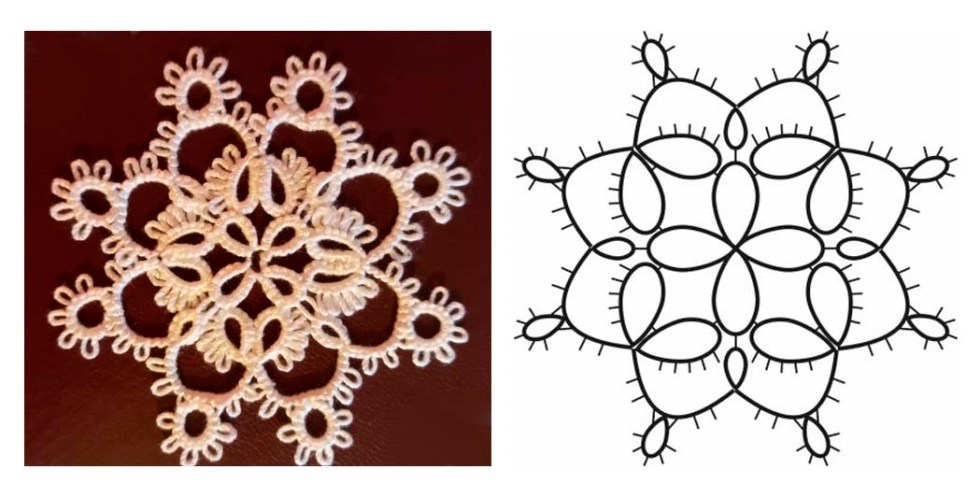
This tutorial is good too, no doubt! Have you noticed that the instructions we reviewed were NOT accompanied by graphical diagrams? Of course, you can look at the photo of the finished snowflake and follow the instructions. But I prefer to combine instruction and graphical diagram in my tutorials.
Aren’t you tired yet? Be patient, because now the fun begins (because this will be my instruction, haha!)
Abbreviation: R – Ring; PVR – previous Ring; C – Chain; PVC – previous Chain; p – picot about 4 mm; sp – picot about 1 mm; jp – join picot; 1S – first shuttle; 2S – second shuttle; TS – two shuttles; tw – turn work.
Row 1
⚫ – beginning row
1S 1, 2, 3. R: 5, sp, 2, p, 2, sp, 5;
4. R: 5, sp, 2, p, 2, sp, 5, tie and cut.
This row consists of four identical rings. Pay attention to the different lengths of the picots. As a result, you should have a flower like in the photo.
Row 2 ⚫ – beginning row 1S
R: 2, p, 1, p, 1, p, 1, p, 1, p, 2, jp to second sp of R2 (Row1), 6, sp, 2;
R: 2. jp to sp of PVR, 6, jp to first sp of R1 (Row1), 2, p, 1, p, 1, p, 1, p, 1, p, 2, tw; TS
Repeat from 1 to 5 3 times, connecting the elements according to the graphic diagram.
Attention! Attach last Chain to beginning Row, tie and cut.
Congratulations! Your Snowflake is ready!
You can take screenshots and save this pattern to your collection. Or you can also download the PDF file from the link. In this file on page 3 there is a graphic chart showing the number of double stitches for more advanced tatters or for those who don’t like to type a lot! 🙂 https://drive.google.com/file/d/1OihtIvhBgnU7ecCThETRcDmefzX_HMa6/view?usp=sharing
So, we looked at several options for How to read tatting patterns. Write to me in the comments which option you like more. Perhaps you would suggest making changes or additions to my instructions. I would be grateful for any comments. Thank you for your support! Please subscribe to my blog and my YouTube channel: https://www.youtube.com/watch?v=5nOMsstL15w&list=UU3dn4_9pp7tIKA2k564wLBQ
FAQ
Q: How do you read numbers in tatting instructions? A: Numbers usually show the number of double stitches between picots or joins. For example, “R 5–5–5–5 cl” means three picots separated by 5 double stitches each.
Q: What do lines mean in tatting diagrams? A: Lines usually represent chains, while circles show rings. The direction of the line helps you follow the working order of the lace.