Posted on 4 Comments

Free Antique tatting lace

A fragment of tatting lace and machine embroidery - border on a handkerchief with a monogram.

Free Antique tatting lace, or let’s give new life to old patterns!

Hello, everyone! Recently, I was commissioned to create a charming collection of handkerchiefs with embroidery and tatted lace. 🪡✨
One of the patterns I used caught my heart immediately — I discovered it in an old booklet printed back in the 1930s! Isn’t that amazing?


Free Antique tatting lace 1

So simple, yet so sweet — this little gem of a design was just asking to be shared. 💖
And how could I resist?

This blog post will be short 🍬 — just a few helpful notes to accompany the video tutorial.
As you probably know, I love adding videos to my posts, and I hope this one brings you both joy and practical tips!

🎥 Watch the tutorial here:
👉 https://youtu.be/-hhM84oTQ2E

📜 Pattern Diagram & Instructions


First of all, you can take a closer look at the diagram and written instructions right here — just scroll down. ⬇️
Or, if you prefer to keep this vintage treasure in your own collection, feel free to download the file using the link below:

📁https://drive.google.com/file/d/1I-wHpNrNnbFis7yyW3mGncmXkHncOGxT/view?usp=sharing

🔄 Starting from the Back? Yes, Please!

Did you notice that we start from the back side of the work? That’s a very important detail!
Why? Because it allows us to make all the Rings from the front side, which is so much more convenient — and prettier too! 💡✨

You probably also spotted the little “paperclip” icon on the diagram. 🤓
Now, let me share a secret with you:
Personally, when working with fine threads, I much prefer using a short piece of extra thread instead of an actual paperclip.
Why? Well, the clip can leave a rather noticeable hole, and as you may already know —
I’m all about that Perfect Tatting! 💖
(If you’ve read my previous blog posts, I’m sure you saw that coming. 😉)

🧵 A Tiny Twist for Perfect Rings!

Here’s something else to notice in the video:
I add an extra half of a double stitch at the end of each ring, and then pull the shuttle through the loop on my hand before forming the next one. 🔄✨

Now, don’t get me wrong — I’m not saying this is the only way to do it!
As we all know, tatting is not dogma — it’s an art! 🎨🪡

But… if you like your rings to look perfectly symmetrical and neat, this little touch might just become your new favorite trick! 😉

🪡 Needle Tatters, This One’s for You!

If you’re working with a needle instead of shuttles, I’ve got a little tip for you too! 🤫
I’ve actually shared a video about it earlier, but here’s the trick in short:

Before closing the ring, give the thread with the double stitches a single twist.
That’s it!

With this simple move, you won’t need to tie extra knots after each ring. 💡
It’s especially lovely when you make two or three rings in a row — the result looks smooth and seamless! ✨💕

🧵 Want to Add a Corner or a Curved Edge?
If you’d like to turn this lace into a corner or create a curved shape instead of a straight edge — you’ll find extra diagrams and tips in the full pattern available in my shop.
https://fairylace.kozinenko.com/product/antique-border-tatting-pattern/

💬 Let’s Keep in Touch!
If you enjoyed this, don’t forget to subscribe, leave a comment, ask questions, or share it with your tatting friends! 💌
And above all — happy tatting! 🧶✨

Posted on 8 Comments

How to Make Ring with Curled

Red tatting earrings heart with curled

How to Make Ring with Curled, or Two-Needle Tatting Tutorial

Hello, everyone! 👋

😕 Unfortunately, I received very few comments on my teaser video for the “How to Make a Curled Ring” tutorial. Honestly, I felt a bit confused and even a little shy. Is this topic not interesting for you? Or maybe my explanations weren’t clear enough? Perhaps social media users just skip the video descriptions? 😅
Or… did you miss my short call-to-action video on YouTube?

📣 If so, maybe it’s time to subscribe and become a little more active on my channel?
👉 youtube.com/@ElenaKozinenko

How to Make Ring with Curled 1

✨ But no worries! I’ve decided to treat my most loyal and curious followers. So today I present to you a detailed step-by-step tutorial and supporting video on how to make a Curled Ring using two-needle tatting technique!

To get started, you’ll need just a few simple tools:
✨ thread,
✨ two tatting needles of the same size,
✨short pieces of contrasting thread, each about 10 cm (4 inches) long,
✨ and a small pair of scissors.

🔍 Important note: Make sure your thread thickness matches the size of your needles. I used #5 tatting needles and #10 mercerized cotton thread.

How to Make Ring with Curled 2

🧰 What You’ll Need for to Make Ring with Curled

But don’t worry — you can choose different needles and threads. In this case, it won’t affect the technique, only the final size of the curled ring. So feel free to experiment! 🎨😊

How to Make Ring with Curled 3

🔹 Step 1: Start with the First Needle

Take the first needle and make 3 double stitches.

✂️ The needle thread can be around 20–30 cm long — short enough to handle easily, but long enough so it doesn’t slip out of the needle. Just make sure it’s comfortable to work with!

🔹 Step 2: Work with the Second Needle

Now take the second needle and make 25 double stitches using the ball thread.

Here are two important tips to keep in mind:
1️⃣ Hold the needle backward, with the eye of the needle pointing forward.
2️⃣ Start your stitches right next to the ones made with the first needle. There should be no gap between them!

These small details make a big difference — so don’t skip them! 😉

How to Make Ring with Curled 4

🔹 Step 3: Measure and Cut the Ball Thread

Now that you have 25 double stitches on the second needle, it’s time to measure out 4.5 meters of the ball thread and cut it off.

✂️ This way, you’ll have a long enough thread to complete the entire curled ring without needing to add more thread later.

Plus, you’ll now have a free end of the ball thread that can easily be inserted into the eye of the second needle. Neat and practical! 😉

🔹How to Make Ring with Curled Step 4: Forming the First Chain

Insert the free end of long cut thread into the eye of the second needle.
Then gently pull the thread through the 25 double stitches, forming an Cain.

🚫 Don’t rush! Try not to tangle the long piece of thread.
But don’t worry — with every new Chain, the thread will become shorter, and pulling it through will get easier and easier. 😌

⚠️ Be very careful at this step!
Before tightening the arc completely, insert a helper thread into the loop at the base of the Chain.

✨ This little trick will do you a big favor:
✔️ it makes shaping the curl much easier,
✔️ it keeps the end of the Chain neat and strong,
✔️ and it helps you gently arrange the curled elements later.

You’ll thank yourself for taking this extra step! 💡🧶

🔹 Step 5: Tighten the Chain

Now tighten the chain well to create a nice, clean curl.

✨ And here’s what you should have — a beautiful, elegant swirl forming before your eyes!

🔹 Step 6: Continue Working with the First Needle

Pull the thread out of the second needle (you can set it aside for now) and use this long ball thread to make 8 double stitches on the first needle.

You’re now slowly building the total number of stitches needed to form the ring on the first needle.

🔁 Important: Do not pull the first needle through your work yet — keep it in place until it’s time to close the ring.

🔹 How to Make Ring with Curled Step 7: Repeat and Create the Full Pattern

Now bring the second needle back into action and repeat Steps 2 through 6.

That means you’ll be making 6 curled chains, with 8 double stitches in between them — all on the first needle.

⚠️ Attention!
At the very end, instead of 8 double stitches, make only 5 double stitches on the first needle.

🌀 This way, you’ll have 6 equal segments between the curls — nice, symmetrical, and perfectly balanced.

🔹 Step 8: Close the Ring and Finish Your Work How to Make Ring with Curled

Now pull the first needle through all the double stitches you’ve made on it and form the ring.

🎀 Tie a secure knot, hide the thread tails, and trim the excess.

And finally — the most satisfying part! — arrange all the curls nicely.

🌟 (Did you notice how helpful those extra helper threads were? They make it so much easier to shape the curls neatly!)

🔹 Finishing Touches – and a Video Tutorial, Too!

As the final step in your How to Make Ring with Curled project, carefully remove the helper threads, holding the curls gently in place as you do so.

💧 If needed, you can lightly apply a stiffening solution to the ring to keep its shape — then let it dry completely.

📽️ And as always, I’ve prepared a step-by-step video tutorial to accompany this written guide:
“How to Make Ring with Curled” — on my YouTube channel! https://www.youtube.com/watch?v=DTYHweVcikw&list=PLmUVrN61lH3xQZumGGsR2DEL1BADRW6cV

🔹 Loved this technique? Try the next step! ❤️

If you’ve mastered the How to Make Ring with Curled method and feel inspired to try something a bit more advanced, why not create a whole Heart with Curls?

💖 This lovely heart combines the same swirling elements into a graceful, romantic shape — perfect for gifts, decor, or just pure tatting joy!

🎓 You’ll find the detailed PDF tutorial and a supporting video here:
👉 Heart Curls of Love Pattern

Take your tatting to the next level — and let your heart swirl with creativity! ✨🪡

Posted on Leave a comment

How to adapt tatting pattern

How to adapt tatting pattern

How to adapt tatting pattern, or how to make a flat doily from a ball.

Hello everyone! Today’s article will be very useful not only for beginner tatterers, but also for experienced lace makers, I’m sure!
In a comment to one of my previous articles, Debra asked if it was possible to make a round Doily from Christmas Clover by Kendra Goodnow.

How to adapt tatting pattern 1

I found Kendra’s pattern on Handy Hands’ website. You can download this file by clicking on the link: https://hhtatting.com/wp-content/uploads/2021/07/Tatted-Christmas-CloverB.pdf

This is a wonderful decoration for your Christmas tree ball!

Debra, I apologize for my inattention! But I made an adaptive pattern for 15 cm in diameter (I forgot, you asked for 4 inches). But I hope this method will help you make any size yourself!

How to adapt tatting pattern 2

By the way, Kendra’s pattern is free, so we are not violating anyone’s copyright. So, we take the graphic diagram from the downloaded file. Using a computer program, I made a diagram measuring 15 cm in diameter. And now we need to print it out. By the way, if you are not sure about your computer program, you can check the size of the printed template with a ruler. Mine was exactly 15 cm!

And now we have some painstaking but very useful work ahead of us. This way you will avoid big mistakes in the finished product. We need to make test elements for all the Rings and Chains of the pattern. Of course, we do not take into account the repeating elements!

In the video you will see that the first row turned out to be unchangeable.

But in the second row we had to change some Rings and all the chains. Of course, because we need to get an even doily from the ball.

I changed the number of double stitches and added some picots.

How to adapt tatting pattern

As a result, I got this adapted scheme. You can download this file for free by following the link: https://drive.google.com/file/d/1xexJNGF8tQWLt5UXAkGMwxJuUwQs-cLY/view?usp=sharing

I suggest you make a round doily size 15 cm in diameter, threads No. 20!

So now, when you are asked how to adapt tatting pattern, you can confidently answer: easy! And of course, you can watch a video illustrating the process described: https://youtu.be/k3l88qw_Yc4

You can read more articles on my blog, welcome: https://fairylace.kozinenko.com/blog/

Thanks for your support, happy tatting!

Posted on Leave a comment

Perfect tatting – part 8

Round white tatting doily

Perfect tatting – part 8.

Hello everyone! This is the eigth lesson in the series Perfect Tatting. You can read previous part here: https://fairylace.kozinenko.com/perfect-tatting-part-7/
Also my articles will be accompanied by video tutorials. Simultaneously with the article I will add them to my YouTube channel.

Please write in the comments what subtleties you would like to know. Then it will be easier for me to make a lessons plan.

Also you can ask me questions in the comments, I’m ready to help!

So, today I want to take a closer look at the importance of number placement in tatting graphic designs. I already told you that the number is placed above the “cap”, this is logical and simplifies the drawing (read here: https://fairylace.kozinenko.com/perfect-tatting-part-6/ ).

I suggest going back to the pattern from part 6. Graphic diagrams are also added to today’s video.
To make the pattern easier to read, I write the abbreviation and instructions.

Option 1

Perfect tatting - part 8. Option 1

Abbreviations:
R – Ring;
PVR – previous Ring;
C – Chain;
sp – small picot;
jp – join picot;
1S – one shuttle;
TS – two shuttles;
tw – turn of work.

1S 1. R: 15, sp, 5, tw;
TS 2. C: 10, tw;
1S 3. R. 5, jp to sp of PVR.

Option 2

This option for two shuttles.

Abbreviations:
R – Ring;
PVR – previous Ring;
C – Chain;
PVC – previous Chain;
sp – small picot;
jp – join picot;
1S – one shuttle;
TS – two shuttles.

Perfect tatting - part 8, option 2

1S 1. R: 15, sp, 5;
TS 2. C: 5, jp to sp of PVR, 5, sp, 5;
1S 3. R: 5, jp to sp of PVC, 15.

Option 3

Perfect tatting - part 8, option 3

This option for shuttle and ball.

Abbreviations:
R – Ring;
PVR – previous Ring;
C – Chain;
PVC – previous Chain;
sp – small picot;
jp – join picot;
sk – simple knot to swap the threads;
1S – one shuttle;
S + B – shuttle and ball.

1S 1. R: 15, sp, 5, sk;
S + B 2. C: 5, jp to sp of PVR, 5, sp, 5, sk;
1S 3. R: 5, jp to sp of PVC, 15.

Option 4

Abbreviations:
R – Ring;
PVR – previous Ring;
C – Chain;
PVC – previous Chain;
sp – small picot;
jp – join picot;
pk – one pearl knot to secure chain ( on the graphical diagram it is indicated by a star);
1S – one shuttle;
TS – two shuttles;
ts – turn of work.

Perfect tatting - part 8, option 4

юю

So, you see how important the placement of the numbers in the drawing is. Also, I think my detailed instructions will help you better understand how to read tatting patterns. After all, I add instructions to the drawings and photos. Actually, I do this for all my designs. I hope my long article didn’t bore you! Because the video is also quite long: https://www.youtube.com/watch?v=w3qcvpiizmw&list=UULF3dn4_9pp7tIKA2k564wLBQ

Perfect Tatting – Part 8 is finished! Happy weekend!
I hope my previous blog posts will also be useful and interesting: https://fairylace.kozinenko.com/blog/

Posted on 2 Comments

Perfect tatting – part 6

Perfect tatting - part 6. free tatting tutorial

Perfect tatting – part 6.

Hello everyone! This is sixth lesson in the series Perfect Tatting. You can read previous part here: https://fairylace.kozinenko.com/perfect-tatting-part-5/

Also my articles will be accompanied by video tutorials. I will add them to my YouTube channel.

Please write in the comments what subtleties you would like to know. Then it will be easier for me to make a lessons plan.

Today I show several graphic tatting designs and explain how to “read” them.

First, look at what shapes can be used to depict rings, chains, and picots. In fact, everything here depends on the creative imagination of the designer or the computer program used.

Perfect tatting

Rings can be drawn round, oval, teardrop-shaped. Next time I will tell you how to easily give ready-made rings different shapes.
And chains can be depicted as an arc with different bending amplitudes.
Well, Pico is usually depicted as a short straight segment. Sometimes designers draw a small oval. But it seems to me that such a depiction of Pico is not very logical. By the way, this is another of the following topics.

Ideal tatting

So, let’s see what kind of image options we can get.

In fact, these are variations of the graphic representation of the same pattern. This is what this pattern looks like in its finished form.

Where to put the numbers for the design perfect tatting

The standard tatting knot consists of two “legs” and one “cap” above them. The ABC website says the following:
“Cap: A cap is the bump above the legs of a double stitch. It is an easy term to remember as most people wear a cap on their head which is above their legs”. https://abctattingpatterns.com/terms/

Therefore, it seems quite logical to me to place the numbers above the caps.

Perfect tatting – part 6

But what to do in this case? There is no space for numbers around the Rings!

Perfect tatting – part 6

It’s very simple. We’ll put the numbers inside the ring. Especially since it doesn’t change the location of the caps and legs in the ring. I’m not considering options where the caps are inside the ring right now.

Perfect tatting – part 6

You can also simplify the pattern by writing one number in the ring. This is possible if all parts of the ring contain the same number of double stitches. For example, I took 5 ds.

With chains it’s more complicated. I think it’s best to put the numbers ABOVE the caps. That way the tatter can see the direction of the work right away. And this is especially important to determine where to turn the work.

So, I will show you two variations of the Ring – Chain – Ring pattern.

  1. R: 15, sp, 5, tw;
  2. C: 10, tw;
  3. R: 5, jp to sp of PVR, 15.
  1. R: 15, sp, 5;
  2. C: 5, jp to sp of PVR, 5, sp, 5;
  3. R: 5, jp to sp of PVC, 15.

Oh, thank you for your patience! You had to read for a long time. But I made a very short video: https://www.youtube.com/watch?v=QtM9uDZ2dq0&list=UULF3dn4_9pp7tIKA2k564wLBQ

Perfect Tatting – Part 6 is finished! Happy perfect tatting!
I hope my previous blog posts will also be useful and interesting: https://fairylace.kozinenko.com/blog/

Posted on 2 Comments

Perfect tatting – part 2.

Tatting round doily dark green and orange colors

Perfect tatting – part 2.

Hello everyone! This is the second lesson in the series Perfect Tatting. You can read the first part here: https://fairylace.kozinenko.com/perfect-tatting-part-1/

My articles will be accompanied by video tutorials. I will add them to my YouTube channel.

Please write in the comments what subtleties you would like to know. Then it will be easier for me to make a lesson plan.

Today I want to talk about joining picots. As an example, I took the pattern of the simplest flower made of five identical Rings.

Perfect tatting

You can choose any number of double stitches in the Ring, as you like. I took for the needle: 5, p, 5, p, 5, p, 5. And for the shuttle 3, p, 5, p, 5, p, 3.

Perfect tatting – part 2

I made a ring with three picots of the same size (picot length is about 4 mm).

But after the join picot with the second Ring, there is an extra loop. It looks sloppy.

However, there are patterns where such picots are exactly what is required by the drawing! Usually the designer specifies the length of the picots in such cases. In any case, I try to write in all instructions what length of picots should be made.

Perfect tatting – Small joining picot

In the graphic diagram you can see that the first and third picots of each Ring are joining ones. That’s why I made these picots very small. And as a result, my flower looks neat, doesn’t it? But if you make the joining picots about 8 mm long, you get a very interesting effect. Oh, sorry, I got distracted!

When joining through a picot, please use a crochet hook. Of course, using the “nose” of the shuttle is faster, I agree. But in this case, the small picot will stretch. And we strive for perfection! By the way, the request to use a hook also applies to needle tatters!

I hope you will enjoy watching the video: https://www.youtube.com/watch?v=BlGFuxWyI1g&list=UULF3dn4_9pp7tIKA2k564wLBQ

Perfect Tatting – Part 2 is finished! Thank you for your patience!
I hope my previous blog posts will also be useful and interesting: https://fairylace.kozinenko.com/blog/

Posted on 4 Comments

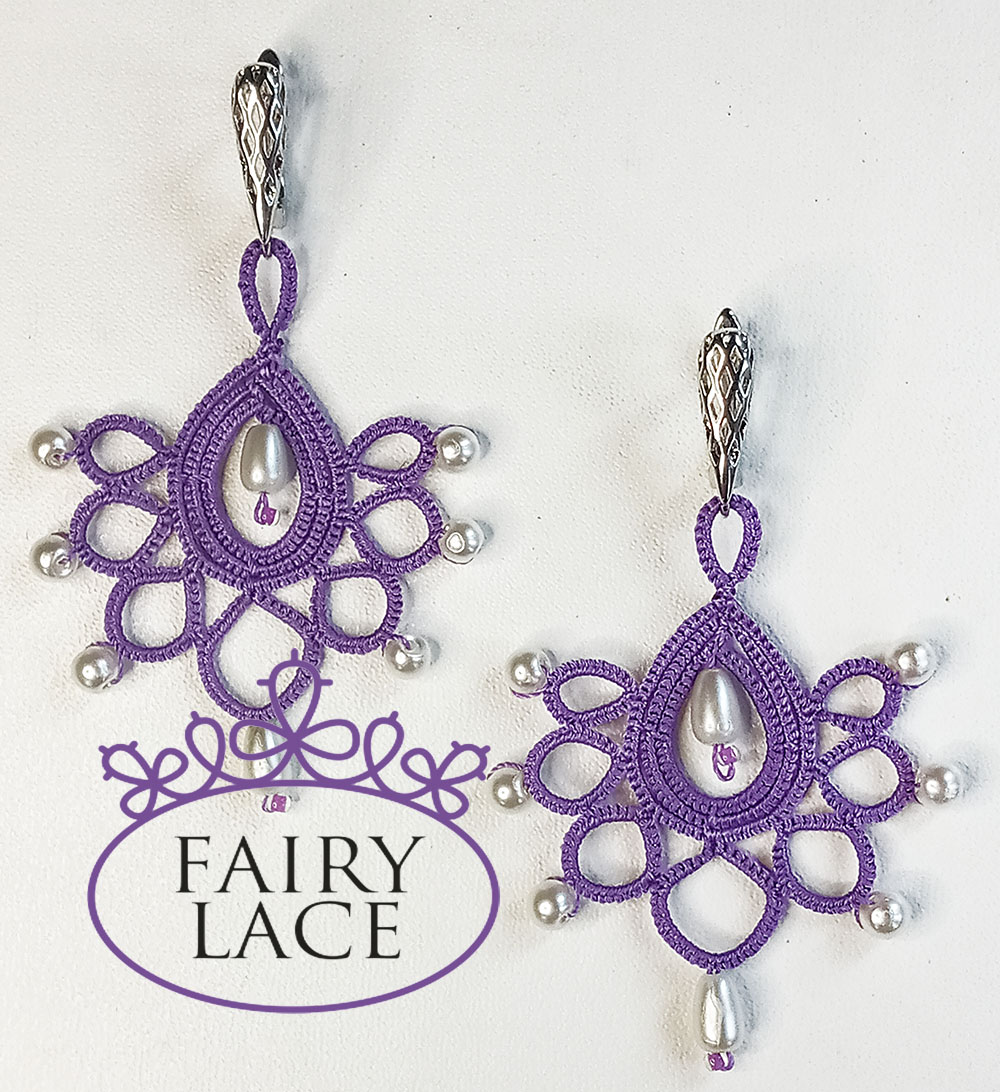
Free tutorial tatting earrings Nancy

Free tutorial tatting earrings Nancy, or a continuation of my gratitude jewelry collection.

Hello everyone! I named these earrings after my dear friend, amazingly touching lady with a big heart. She lives in a nature reserve and cares deeply about animals and pets. I greatly appreciate our friendship and correspondence. Thank you for your support, sympathy, help and prayers, my dear Nancy!

You can follow my written instructions along with watching the video. The PDF file can be downloaded for free by following the link: https://drive.google.com/file/d/1nm9DK5De9Yo66s9WUlfHvYY_OhullmKf/view?usp=sharing

I wrote a detailed list of the necessary materials and tools at the beginning of the video lesson. I used my favorite light purple color, of course! But you can take threads and beads of any color you like!

To perfectly connect the rows, I used an embroidery needle. You can watch a short video of how it works: https://www.youtube.com/shorts/PzSGJ5vIBEY But you can make the Catherine Wheel Join, or another connection convenient for you. I just chose the fastest and easiest!

I also used a pearl knot to create a sharp angle at the top of the earrings. Video available, please: https://www.youtube.com/watch?v=3Z4e9CiW4uY&list=UULF3dn4_9pp7tIKA2k564wLBQ&index=54

So, watch the detailed video on my channel. I hope you enjoy making these earrings with me, welcome: https://youtu.be/unUGan77IaU

You can support my channel with likes, reposts and comments!
Thanks in advance to everyone who donates to my PayPal: fish20085@gmail.com
Thank you!

Posted on 8 Comments

Floating rings

Floating rings

Floating rings, or tatting poetry. Tips for beginner tatters. Part 5. Part 4 of my articles for beginning tatters can be read here: https://fairylace.kozinenko.com/vintage-buttons/

Hello everyone!

In this article I will try to tell in detail how to make Floating Rings. Oh, what a romantic name this element has! And although this verse is not about needlework, there is a mention of these rings here:
Friday Saturday rags of clouds
floating rings driven through the sky
and fluorescent halos
celestial laundry tossed.
Where did I find this? You will not believe! On Amazon, haha. This is a quote from the poetry textbook “Unlocking the poem” by Ottone M. Riccio and Ellen Beth Siegel. Yes, yes, don’t be surprised. Turns out there are textbooks for everything you want to learn. You just need to be able to “enter the correct search words.” That’s what my eldest son says. He is Principal Solutions Architect and Google Cloud Certified Fellow. Therefore you can believe him, I assure you!

So, from the novel, let’s move on to practice. Let’s make a little round motif. For clarity, I made a graphic diagram and filmed a video lesson. And of course, instructions with videos are made for shuttles and needles. That’s right, in plural. Because to perform such an element you will need two shuttles or two needles. By the way, please note that the needles must be the same thickness.

Pattern

You can download the PDF file by following the link: https://drive.google.com/file/d/1kA3-0HMAX-AKjILwTQ5TNidQidNzaM5p/view?usp=sharing
Or just take a screenshot of the screen. But on the screen, the link to the video will be inactive. Oh, I forgot to say. My cat Phil tried very hard and helped me work on the video!

Video: https://youtu.be/76B3p2HPa_M

Please don’t forget to subscribe to my blog, comment and share on social media. Your help and support is very important to me.
I will also be grateful for any charitable contribution to my Paypal: fish20085@gmail.com

Posted on 8 Comments

Vintage buttons

How to Use Vintage Buttons in Lace

Vintage buttons. Tips for beginner tatters. Part 4 , or how to add a beautiful button to a tatting pattern. Part 3 of my articles for beginning tatters can be read here: https://fairylace.kozinenko.com/tips-for-needle-tatters/

Hello everyone! I’ve recently been organizing my craft supplies. Ah, I have to do this from time to time! To you too? And among the three kilograms of buttons, I found several pieces that interested me.

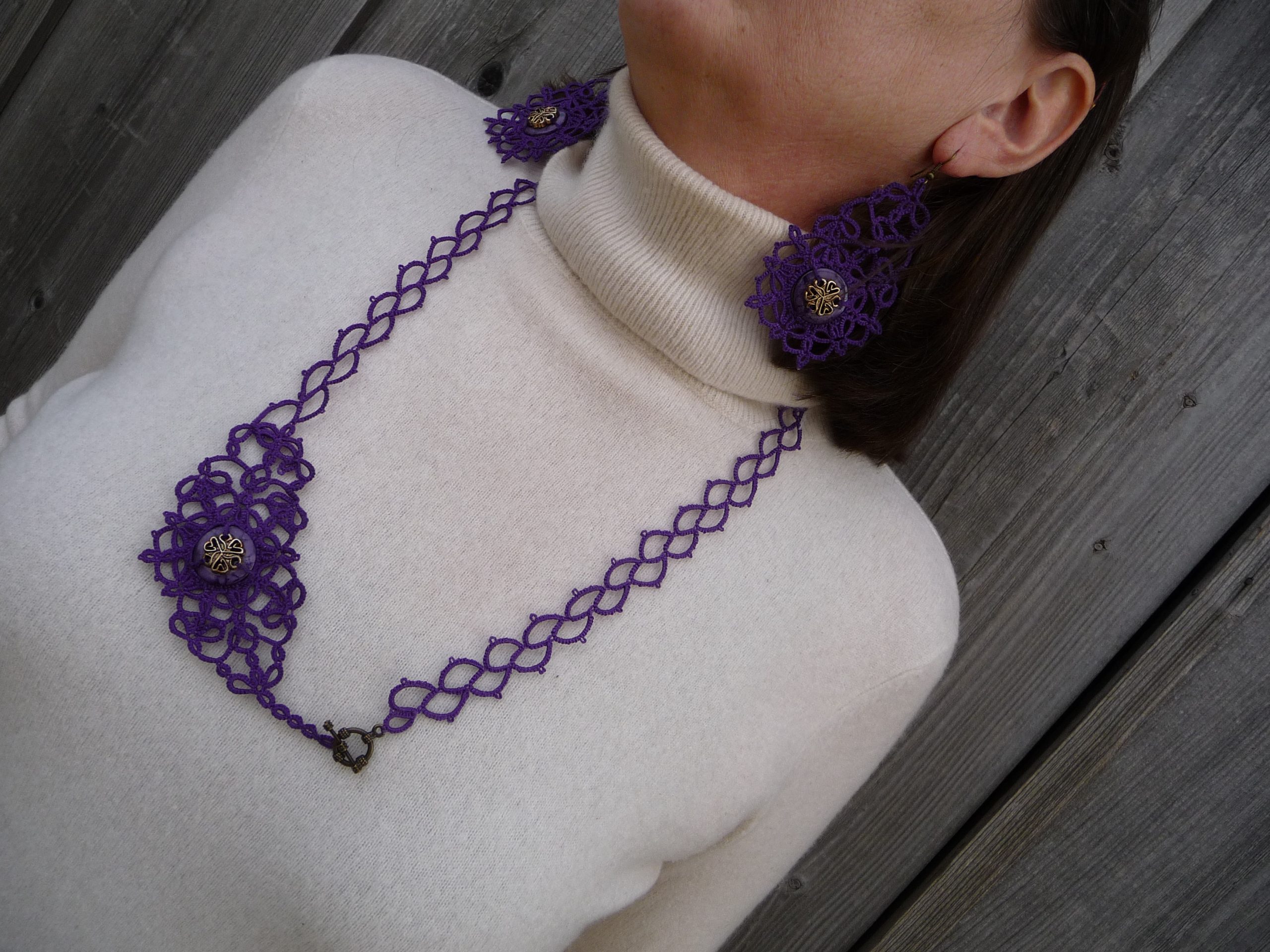
vintage button

Often I have seen round buttons added to tatting patterns. I made such a heart (this was 12 years ago).

But these are rectangular buttons. Can they be used? Why not?

As usual, I didn’t stop at shuttles only. After all, for those who tat with a needle, it is also interesting to make a small brooches with a vintage buttons. Do you agree?
The pattern is very simple. Because the main thing in this pattern is the rectangular button!

Use a crochet hook when making connections. Choose a hook that will fit easily into the button hole.

I decided it wasn’t worth doing graphic design. Therefore, I simply put numbers indicating the number of double stitches directly on the photo. You can take a screenshot or download a PDF file from the link: https://drive.google.com/file/d/13Oct1mUyQuwGVzr2P08M3uobKR098UNH/view?usp=sharing

Tatting with button
Tatting with button

Educational video on my YouTube channel. Please take a look and come back! https://www.youtube.com/watch?v=ldSiIp_3CeA&list=UULF3dn4_9pp7tIKA2k564wLBQ

Some useful tips for tat with vintage buttons

Of course, if the buttons are dirty, they need to be washed and dried.

As you work, try to tighten the loops inside the button tightly. Otherwise, the button will not be firmly secured in the middle of the pattern. But we don’t want the buttons to “dangle or float” in space!

Another important point. Try to ensure that the threads on the button lie parallel and do not twist with each other. This will make your work look neater.

When watching a video please note that I respect the front and back sides when weaving. It seems to me that in this case the picots look more beautiful.

The two motifs are made with the same threads and the same pattern. But with the shuttle and needle ready, the motif turns out to be of different sizes.

Please don’t forget to subscribe to my blog, comment and share on social media. Your help and support is very important to me.
I will also be grateful for any charitable contribution to my Paypal: fish20085@gmail.com

Posted on 4 Comments

Cro-tatting Lesson 7

Free tatting pattern

Cro-tatting Lesson 7 , or translation difficulties.

Hello everyone! This article is a continuation of Lesson 6. Therefore, follow the link if you have not read or watched the video of the previous lesson: https://fairylace.kozinenko.com/cro-tatting-lesson-6/

Lesson 7

At first I wanted to start this article with the story of the Tower of Babel. Well, you remember how God gave people different languages so that they would not understand each other. But then I thought that this is not entirely true. The question is philosophical. Because very often, speaking the same language, people cannot understand each other. Probably, this happens because many people have forgotten how to listen, empathize and understand others. And the notation in English for crocheting terms me to such reflections. How can I figure this out, I have no idea! LOL

But I’m pretty creative, you know. Therefore, I decided to write an abbreviation for UK and for US. Hope you don’t get confused!

So, today I invite you to make a small round motif with two rows. We will make the second row with single crochets. Yep, that’s where we got it! Don’t worry, we’ll fix it. UK terms – dc ( double crochet ), US terms – sc ( single crochet ).

Row 1

The first row consists of Rings and Chains. The chains in cro-tatting are crocheted and form an “arc” of air loops (in the abbreviation сh).

Row 2

In the second row, I used rings and single crochets ( or double crochet ) . Please note that before performing the Ring, you need to turn the work. And since you are getting the wrong side, it is better to start a double stitch from the second half. You will clearly see in the photo how the front side (pink ring) differs from the wrong side (yellow ring).

For clarity, of course, I made a detailed video. Don’t forget to subscribe, comment and share my video on social media please. https://www.youtube.com/watch?v=KpE8dFoOJtM&list=UULF3dn4_9pp7tIKA2k564wLBQ

FREE PATTERN LESSON 7

You can download the pattern Cro-tatting Lesson 7 by clicking on the link. Or just take a screenshot. https://drive.google.com/file/d/16VtiI2bIQy7RqmpuMJIhbx29agpDibpD/view?usp=sharing

If my articles are interesting and useful to you, subscribe to my blog, comment, share on social networks. Your feedbacks is very interesting and important to me. Don’t forget to check my store, welcome: https://fairylace.kozinenko.com/