Posted on 8 Comments

How to Make Ring with Curled

Red tatting earrings heart with curled

How to Make Ring with Curled, or Two-Needle Tatting Tutorial

Hello, everyone! 👋

😕 Unfortunately, I received very few comments on my teaser video for the “How to Make a Curled Ring” tutorial. Honestly, I felt a bit confused and even a little shy. Is this topic not interesting for you? Or maybe my explanations weren’t clear enough? Perhaps social media users just skip the video descriptions? 😅
Or… did you miss my short call-to-action video on YouTube?

📣 If so, maybe it’s time to subscribe and become a little more active on my channel?
👉 youtube.com/@ElenaKozinenko

How to Make Ring with Curled 1

✨ But no worries! I’ve decided to treat my most loyal and curious followers. So today I present to you a detailed step-by-step tutorial and supporting video on how to make a Curled Ring using two-needle tatting technique!

To get started, you’ll need just a few simple tools:
✨ thread,
✨ two tatting needles of the same size,
✨short pieces of contrasting thread, each about 10 cm (4 inches) long,
✨ and a small pair of scissors.

🔍 Important note: Make sure your thread thickness matches the size of your needles. I used #5 tatting needles and #10 mercerized cotton thread.

How to Make Ring with Curled 2

🧰 What You’ll Need for to Make Ring with Curled

But don’t worry — you can choose different needles and threads. In this case, it won’t affect the technique, only the final size of the curled ring. So feel free to experiment! 🎨😊

How to Make Ring with Curled 3

🔹 Step 1: Start with the First Needle

Take the first needle and make 3 double stitches.

✂️ The needle thread can be around 20–30 cm long — short enough to handle easily, but long enough so it doesn’t slip out of the needle. Just make sure it’s comfortable to work with!

🔹 Step 2: Work with the Second Needle

Now take the second needle and make 25 double stitches using the ball thread.

Here are two important tips to keep in mind:
1️⃣ Hold the needle backward, with the eye of the needle pointing forward.
2️⃣ Start your stitches right next to the ones made with the first needle. There should be no gap between them!

These small details make a big difference — so don’t skip them! 😉

How to Make Ring with Curled 4

🔹 Step 3: Measure and Cut the Ball Thread

Now that you have 25 double stitches on the second needle, it’s time to measure out 4.5 meters of the ball thread and cut it off.

✂️ This way, you’ll have a long enough thread to complete the entire curled ring without needing to add more thread later.

Plus, you’ll now have a free end of the ball thread that can easily be inserted into the eye of the second needle. Neat and practical! 😉

🔹How to Make Ring with Curled Step 4: Forming the First Chain

Insert the free end of long cut thread into the eye of the second needle.
Then gently pull the thread through the 25 double stitches, forming an Cain.

🚫 Don’t rush! Try not to tangle the long piece of thread.
But don’t worry — with every new Chain, the thread will become shorter, and pulling it through will get easier and easier. 😌

⚠️ Be very careful at this step!
Before tightening the arc completely, insert a helper thread into the loop at the base of the Chain.

✨ This little trick will do you a big favor:
✔️ it makes shaping the curl much easier,
✔️ it keeps the end of the Chain neat and strong,
✔️ and it helps you gently arrange the curled elements later.

You’ll thank yourself for taking this extra step! 💡🧶

🔹 Step 5: Tighten the Chain

Now tighten the chain well to create a nice, clean curl.

✨ And here’s what you should have — a beautiful, elegant swirl forming before your eyes!

🔹 Step 6: Continue Working with the First Needle

Pull the thread out of the second needle (you can set it aside for now) and use this long ball thread to make 8 double stitches on the first needle.

You’re now slowly building the total number of stitches needed to form the ring on the first needle.

🔁 Important: Do not pull the first needle through your work yet — keep it in place until it’s time to close the ring.

🔹 How to Make Ring with Curled Step 7: Repeat and Create the Full Pattern

Now bring the second needle back into action and repeat Steps 2 through 6.

That means you’ll be making 6 curled chains, with 8 double stitches in between them — all on the first needle.

⚠️ Attention!
At the very end, instead of 8 double stitches, make only 5 double stitches on the first needle.

🌀 This way, you’ll have 6 equal segments between the curls — nice, symmetrical, and perfectly balanced.

🔹 Step 8: Close the Ring and Finish Your Work How to Make Ring with Curled

Now pull the first needle through all the double stitches you’ve made on it and form the ring.

🎀 Tie a secure knot, hide the thread tails, and trim the excess.

And finally — the most satisfying part! — arrange all the curls nicely.

🌟 (Did you notice how helpful those extra helper threads were? They make it so much easier to shape the curls neatly!)

🔹 Finishing Touches – and a Video Tutorial, Too!

As the final step in your How to Make Ring with Curled project, carefully remove the helper threads, holding the curls gently in place as you do so.

💧 If needed, you can lightly apply a stiffening solution to the ring to keep its shape — then let it dry completely.

📽️ And as always, I’ve prepared a step-by-step video tutorial to accompany this written guide:
“How to Make Ring with Curled” — on my YouTube channel! https://www.youtube.com/watch?v=DTYHweVcikw&list=PLmUVrN61lH3xQZumGGsR2DEL1BADRW6cV

🔹 Loved this technique? Try the next step! ❤️

If you’ve mastered the How to Make Ring with Curled method and feel inspired to try something a bit more advanced, why not create a whole Heart with Curls?

💖 This lovely heart combines the same swirling elements into a graceful, romantic shape — perfect for gifts, decor, or just pure tatting joy!

🎓 You’ll find the detailed PDF tutorial and a supporting video here:
👉 Heart Curls of Love Pattern

Take your tatting to the next level — and let your heart swirl with creativity! ✨🪡

Posted on Leave a comment

How to adapt tatting pattern

How to adapt tatting pattern

How to adapt tatting pattern, or how to make a flat doily from a ball.

Hello everyone! Today’s article will be very useful not only for beginner tatterers, but also for experienced lace makers, I’m sure!
In a comment to one of my previous articles, Debra asked if it was possible to make a round Doily from Christmas Clover by Kendra Goodnow.

How to adapt tatting pattern 1

I found Kendra’s pattern on Handy Hands’ website. You can download this file by clicking on the link: https://hhtatting.com/wp-content/uploads/2021/07/Tatted-Christmas-CloverB.pdf

This is a wonderful decoration for your Christmas tree ball!

Debra, I apologize for my inattention! But I made an adaptive pattern for 15 cm in diameter (I forgot, you asked for 4 inches). But I hope this method will help you make any size yourself!

How to adapt tatting pattern 2

By the way, Kendra’s pattern is free, so we are not violating anyone’s copyright. So, we take the graphic diagram from the downloaded file. Using a computer program, I made a diagram measuring 15 cm in diameter. And now we need to print it out. By the way, if you are not sure about your computer program, you can check the size of the printed template with a ruler. Mine was exactly 15 cm!

And now we have some painstaking but very useful work ahead of us. This way you will avoid big mistakes in the finished product. We need to make test elements for all the Rings and Chains of the pattern. Of course, we do not take into account the repeating elements!

In the video you will see that the first row turned out to be unchangeable.

But in the second row we had to change some Rings and all the chains. Of course, because we need to get an even doily from the ball.

I changed the number of double stitches and added some picots.

How to adapt tatting pattern

As a result, I got this adapted scheme. You can download this file for free by following the link: https://drive.google.com/file/d/1xexJNGF8tQWLt5UXAkGMwxJuUwQs-cLY/view?usp=sharing

I suggest you make a round doily size 15 cm in diameter, threads No. 20!

So now, when you are asked how to adapt tatting pattern, you can confidently answer: easy! And of course, you can watch a video illustrating the process described: https://youtu.be/k3l88qw_Yc4

You can read more articles on my blog, welcome: https://fairylace.kozinenko.com/blog/

Thanks for your support, happy tatting!

Posted on 2 Comments

Perfect tatting – part 6

Perfect tatting - part 6. free tatting tutorial

Perfect tatting – part 6.

Hello everyone! This is sixth lesson in the series Perfect Tatting. You can read previous part here: https://fairylace.kozinenko.com/perfect-tatting-part-5/

Also my articles will be accompanied by video tutorials. I will add them to my YouTube channel.

Please write in the comments what subtleties you would like to know. Then it will be easier for me to make a lessons plan.

Today I show several graphic tatting designs and explain how to “read” them.

First, look at what shapes can be used to depict rings, chains, and picots. In fact, everything here depends on the creative imagination of the designer or the computer program used.

Perfect tatting

Rings can be drawn round, oval, teardrop-shaped. Next time I will tell you how to easily give ready-made rings different shapes.
And chains can be depicted as an arc with different bending amplitudes.
Well, Pico is usually depicted as a short straight segment. Sometimes designers draw a small oval. But it seems to me that such a depiction of Pico is not very logical. By the way, this is another of the following topics.

Ideal tatting

So, let’s see what kind of image options we can get.

In fact, these are variations of the graphic representation of the same pattern. This is what this pattern looks like in its finished form.

Where to put the numbers for the design perfect tatting

The standard tatting knot consists of two “legs” and one “cap” above them. The ABC website says the following:
“Cap: A cap is the bump above the legs of a double stitch. It is an easy term to remember as most people wear a cap on their head which is above their legs”. https://abctattingpatterns.com/terms/

Therefore, it seems quite logical to me to place the numbers above the caps.

Perfect tatting – part 6

But what to do in this case? There is no space for numbers around the Rings!

Perfect tatting – part 6

It’s very simple. We’ll put the numbers inside the ring. Especially since it doesn’t change the location of the caps and legs in the ring. I’m not considering options where the caps are inside the ring right now.

Perfect tatting – part 6

You can also simplify the pattern by writing one number in the ring. This is possible if all parts of the ring contain the same number of double stitches. For example, I took 5 ds.

With chains it’s more complicated. I think it’s best to put the numbers ABOVE the caps. That way the tatter can see the direction of the work right away. And this is especially important to determine where to turn the work.

So, I will show you two variations of the Ring – Chain – Ring pattern.

  1. R: 15, sp, 5, tw;
  2. C: 10, tw;
  3. R: 5, jp to sp of PVR, 15.
  1. R: 15, sp, 5;
  2. C: 5, jp to sp of PVR, 5, sp, 5;
  3. R: 5, jp to sp of PVC, 15.

Oh, thank you for your patience! You had to read for a long time. But I made a very short video: https://www.youtube.com/watch?v=QtM9uDZ2dq0&list=UULF3dn4_9pp7tIKA2k564wLBQ

Perfect Tatting – Part 6 is finished! Happy perfect tatting!
I hope my previous blog posts will also be useful and interesting: https://fairylace.kozinenko.com/blog/

Posted on 8 Comments

Vintage buttons

How to Use Vintage Buttons in Lace

Vintage buttons. Tips for beginner tatters. Part 4 , or how to add a beautiful button to a tatting pattern. Part 3 of my articles for beginning tatters can be read here: https://fairylace.kozinenko.com/tips-for-needle-tatters/

Hello everyone! I’ve recently been organizing my craft supplies. Ah, I have to do this from time to time! To you too? And among the three kilograms of buttons, I found several pieces that interested me.

vintage button

Often I have seen round buttons added to tatting patterns. I made such a heart (this was 12 years ago).

But these are rectangular buttons. Can they be used? Why not?

As usual, I didn’t stop at shuttles only. After all, for those who tat with a needle, it is also interesting to make a small brooches with a vintage buttons. Do you agree?
The pattern is very simple. Because the main thing in this pattern is the rectangular button!

Use a crochet hook when making connections. Choose a hook that will fit easily into the button hole.

I decided it wasn’t worth doing graphic design. Therefore, I simply put numbers indicating the number of double stitches directly on the photo. You can take a screenshot or download a PDF file from the link: https://drive.google.com/file/d/13Oct1mUyQuwGVzr2P08M3uobKR098UNH/view?usp=sharing

Tatting with button
Tatting with button

Educational video on my YouTube channel. Please take a look and come back! https://www.youtube.com/watch?v=ldSiIp_3CeA&list=UULF3dn4_9pp7tIKA2k564wLBQ

Some useful tips for tat with vintage buttons

Of course, if the buttons are dirty, they need to be washed and dried.

As you work, try to tighten the loops inside the button tightly. Otherwise, the button will not be firmly secured in the middle of the pattern. But we don’t want the buttons to “dangle or float” in space!

Another important point. Try to ensure that the threads on the button lie parallel and do not twist with each other. This will make your work look neater.

When watching a video please note that I respect the front and back sides when weaving. It seems to me that in this case the picots look more beautiful.

The two motifs are made with the same threads and the same pattern. But with the shuttle and needle ready, the motif turns out to be of different sizes.

Please don’t forget to subscribe to my blog, comment and share on social media. Your help and support is very important to me.
I will also be grateful for any charitable contribution to my Paypal: fish20085@gmail.com

Posted on 2 Comments

More and more hearts

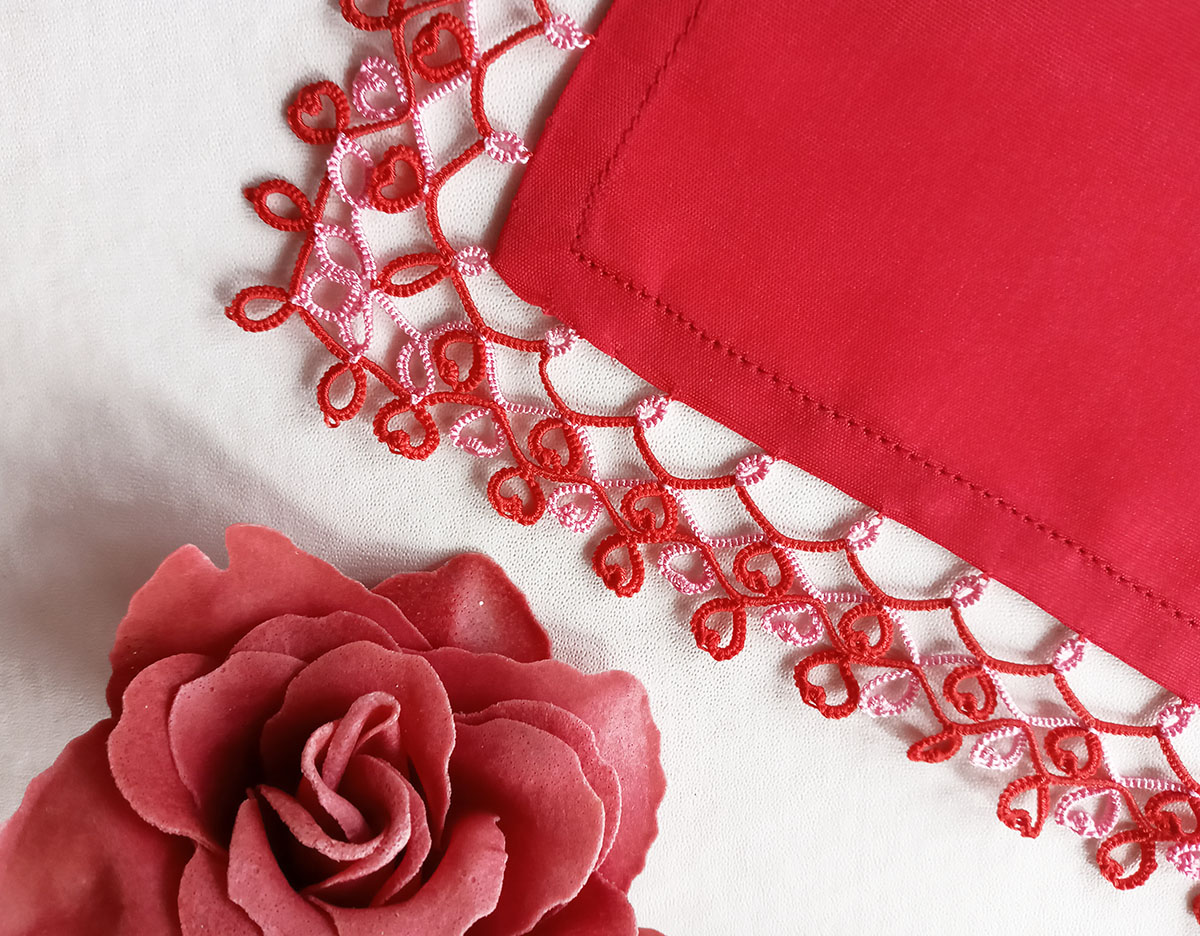
Tatting lace edging with hearts

More and more hearts, or how to make a cute gift for Valentine’s Day.

Hello everyone! Valentine’s Day is literally around the corner! I want to congratulate everyone on this lovely holiday. Of course, not all countries celebrate this day. But it seems to me that this is a great opportunity to say words of love and gratitude to everyone who is dear to us!

If you allow, I will share my tricks on how to make a heart neat and symmetrical.

Of course, I made a short video illustrating my tips.
https://youtu.be/37JNFwIOTiE

Firstly, don’t make the double stitches very tight, this will make your task easier when tightening the ring.
Secondly, you can use the braiding method with a large loop in the middle of the Heart. This is especially useful if you are using thin threads.
Third, if you tat with a needle, make the heart in two parts. By the way, for connecting picot in this case it is better to use a hook rather than a needle.

More and more hearts

When I made three versions of hearts, I got the idea to connect them together. I made a “braid” from the tails of the threads and got a “Three Leaf Clover” from the hearts. I hope you like this idea!

Of course, I couldn’t resist making new hearts pattern for Valentine’s Day. And this time I made More and More hearts – a whole fireworks of hearts! The pattern is available in my store. Check, please: https://fairylace.kozinenko.com/product/pattern-edging-fireworks-of-hearts/

Subscribe to my YouTube channel, follow me on social networks. Support my blog by commenting, liking and sharing!
Happy Valentine’s Day!

Posted on 4 Comments

Variations musical and more

Handmade Christmas garland made of tatting snowflake lace

Variations musical and more, or how music inspired me.

Hello everyone! Do you love classical music? Even if you prefer modern popular music, you have heard the name Beethoven anyway. I’m not talking about the famous St. Bernard dog, LOL, but about the great German composer Ludwig van Beethoven. In any case, in the old days, many people had the ringtone “Fur Elise” by Beethoven on their phones. And all beginning pianists try to learn at least the beginning of the “Moonlight Sonata”. The first part of the sonata (Adagio sostenuto) was called “lunar” by the music critic Ludwig Rellstab in 1832 ? By the way, this happened already 5 years after the author’s death – he compared this work to “moonlight over Lake Firwaldstät.” This sonata has No. 14 and is dedicated to Giulietta Guicciardi. Oh, what a sad love story!

Variations musical and more

Amazing Variations musical in Sonata 32

Beethoven created 32 piano sonatas. I assure you, EVERYTHING is there! You hear the influence of the Viennese classics in the first sonatas. Then you are amazed at the drama and tragedy conveyed by the composer. But the last sonatas are something incredible (in my opinion)! Oh, I’m just in love with Beethoven’s last sonata. Because we hear many unexpected solutions in it. And I love non-standard and fantasy!

First, this sonata is in two movements, a rare exception in classical sonata form. Secondly, listen to how the definition of tempo sounds: Adagio molto semplice e cantabile. That is, very calm, simple and melodious. Thirdly, Beethoven wrote this sonata in 1821-1822, being already ABSOLUTELY deaf. This is incredible! And fourthly ( icing on the cake! ) – for the second movement Beethoven used a theme with five variations and a coda , ta-daaa! Although, I am sure, the complexity of the form is compensated by the “simplicity” of C major. What am I saying? Romanticism, jazz, swing – everything is here! Or is it just me? Hear for yourself how it sounds! https://www.youtube.com/watch?v=ccyHT1sFmsg

And I also learned an interesting fact. In Thomas Mann’s novel Doctor Faustus, in one of the scenes the hero performs Beethoven’s 32nd Sonata. And then the hero delivers a big monologue about the hidden meaning of this music.

“Variations” garland

Now I’m sure you will understand my delight and inspiration! I called my new project Variations. Of course, I’m not as talented as Beethoven. But I tried to implement non-standard and original techniques and forms in small snowflakes. Did I succeed? What do you think? Write to me in the comments please. And also write, are you interested in learning new things not only about tatting? But also about variations musical and more, and more, and more…

The “Variations” garland pattern is available in my store, please check: https://fairylace.kozinenko.com/product/garland-variations-tatting-pattern/

Posted on 6 Comments

Magic simple knot

12 blue-yellow tatting hearts

Magic simple knot, or how to make life easier for yourself.

Hello everyone! First, I want to address my subscribers – participants in the competition for the best name for a doily (posts dated September 11 and 15). The validity period of the discount coupon for the Galaxy Flower doily tatting pattern has been extended until October 30. I sent the coupon code to ALL members. Please check all your email folders.

Now let’s get back to the topic of today’s post. Have you noticed how simple actions sometimes help us make our lives easier? I won’t get too philosophical, LOL! I just suggest that you check whether the SIMPLE knot is truly magical. Yes, yes, I’m talking about the very knot with which we tie our shoelaces. You will be surprised, but it really works!

Shuttle and ball threads

I have already written in previous posts how tatting elements have different names in different languages. One such example is the name of shuttle and ball threads. You might be very surprised. But in my language there are NO such names. The shuttle thread is called the leading thread. Because she seems to direct all the nodes of the work, leading the pattern along with her. And the ball thread is called working thread. Apparently because she forms knots, that is, she works hard!

I do not at all pretend to be a “HISTORIAN OF TATTING”, but I have a theory. At the beginning of the emergence of tatting, the patterns were simple and were made with one shuttle, or a shuttle and a ball. And by the time tatting spread to Eastern Europe, the patterns became more complex. There was a need for two or even three shuttles. In order not to confuse tatters, Europe and America left the same terminology. But the Slavic countries introduced new names, which in my opinion are logical if we use two shuttles.

Just in case, I want to remind new taters, shuttle thread is always on the right (if you are right-handed, of course!).

And now we come to the most interesting part!

You can make many patterns with one shuttle and ball. The trick is this. For example, you need to make a pattern like in the picture. As you can see, this is a pattern for two shuttles. Because the Rings here are made with the second shuttle (this is the shuttle with ball thread).

Try taking one shuttle and a ball! You can swap the threads of the ball and the shuttle using “magic” simple knot! I made a short video to demonstrate this simple but absolutely magical technique! https://www.youtube.com/watch?v=q9c7uiCt3jE&list=UULF3dn4_9pp7tIKA2k564wLBQ

Multicolor patterns

This works if you are making a single color pattern. What if I want to use two colors? I’m sure you remember a simple rule: the color of ball thread determines the color of the Ring or Chain (Wow, I definitely need to write philosophical treatises!). In this case, I take two shuttles with two different colors of thread and make simple knots however I want, LOL! Yes, I received 12 heart options where the color was NOT REPEATED. But I have 12 more options in my head! I liked the result so much that I decided to use this technique to create bookmarks. Of course, you can take threads of any other colors and create as many of your own color options as you like! Experiment, creativity is welcome. The pattern is available in my store. https://fairylace.kozinenko.com/product/pattern-bookmarks-tenderness/

Thank you for reading to the end. I hope I didn’t bore you too much!

Posted on 2 Comments

Bracelet with cute story

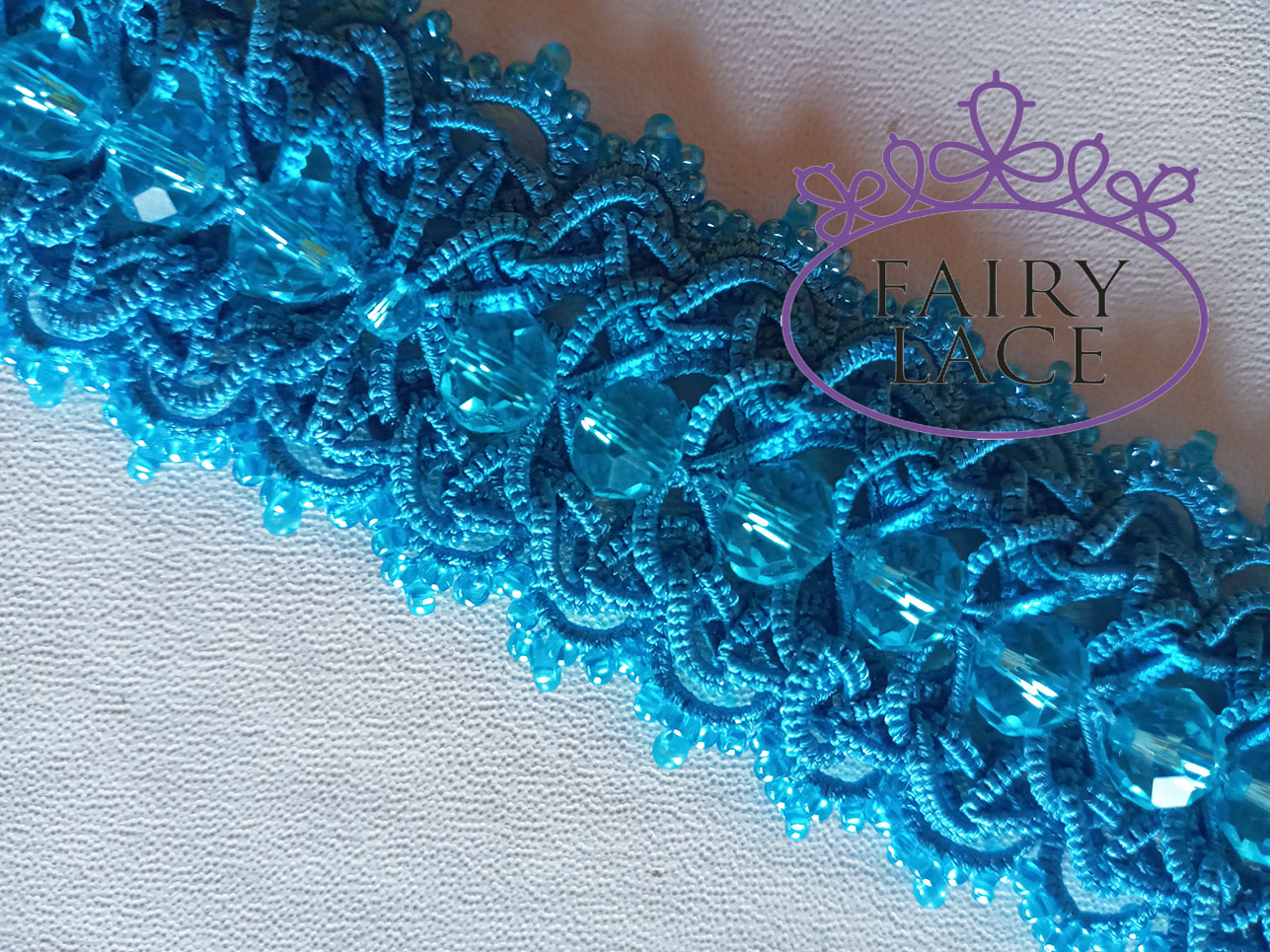
Blue tatting lace bracelet with beads. Handmade by FairyLacefromElena

Bracelet with cute story, or how I was looking for a name for a new bracelet.

When I was picking threads for this bracelet, I imagined a cute Barbie doll. Barbie style suggests just such delicate, romantic and soft colors. But I can’t call my bracelet Barbie, because it could be copyright infringement. I always urge masters to treat copyrights of any artist reverently and honestly. So I went to the internet, haha! By the way, at the same time I learned some interesting facts. You probably know how I love to learn new interesting stories.

Bracelet with cute story

Some facts about Barbie

Barbie first appeared at the children’s goods fair in New York (1959). Ruth and Elliot Handler created this amazing doll. It is believed that the prototype of the famous doll was Bild Lilly, the heroine of erotic comics published in the newspaper “Bild Zeitung” (Germany). Barbie’s full fictional name is Barbara Millicent Roberts.

The first Barbie cost $3. Ah, I can’t even imagine how much a collectible Barbie can cost today!

Nowadays, there are many models of the famous doll and her family and friends. Also huge number of all kinds of accessories, computer games about Barbie are also sold. In 2004, the cartoon “Barbie and the Nutcracker” was filmed. In my opinion, few toys can compete in popularity with this blonde Barbara!

I think you will also like my new bracelet with this cute story. By the way, you can make such a bracelet according to my master class. https://fairylace.kozinenko.com/product/pattern-celtic-bracelet-ballerina/

I also invite you to visit and subscribe to my YouTube channel, welcome: https://www.youtube.com/watch?v=t8pA49htn9U&list=UU3dn4_9pp7tIKA2k564wLBQ

I have to admit that this post was not easy for me. It is hard not to think about grief and misfortune in my country. And I am deeply grateful to everyone who supports and prays for our free, strong and independent Ukraine! Thank you my dear friends!

Posted on 4 Comments

Unknown Paris

Word Paris in black and white with Eiffel Tower as the letter A, minimalist logo, Pixabay free image, uploaded by FairyLacefromElena

Unknown Paris, or 10 facts you haven’t heard of!

Hello everyone!

You may have already seen my new little 3D model of the Eiffel Tower.
You know that this tower is the symbol of Paris, the capital of France. And yes, I’m sure you know the history of this tower. The French at first demanded to remove “this iron monster” and not to spoil the face of the city. But, fortunately, this did not happen. The famous Louvre, Versailles, Montmartre, Champs Elysees … How many famous sights there are in Paris!
But there are several unknown facts. I want to tell you about this.

Unknown Paris

France’s main skyscraper

La Tour First (also called Tour CB31) in the La Défense business district has been considered the tallest building in Paris and France for four years now. The height of the tower, the construction of which took a decade (from 1974 to 2011), is 231 meters.

The largest sundial in the world

The 23-meter obelisk of Luxor, more than 3,300 years old, erected in the Place de la Concorde, was transported to France from Egypt in 1836. The top of the two-ton monument is crowned with a 3.5-meter pyramid, directed towards the sky. This is not just a historical treasure, painted with ancient hieroglyphs to glorify Pharaoh Ramses II, but the largest (and possibly the oldest) sundial in the world.

Only one road sign STOP

There is only one stop sign in all of great Paris. You can look at the metropolitan curiosity in the 16th arrondissement. You ask why the sign is not used? The traffic system in Paris is such that drivers on the right always have an advantage on the road.

Shortest street

Rue des Degrés, the shortest street in Paris, is only 5 meters 75 centimeters long. The record holder is located in the 2nd arrondissement, between the Bonne Nouvelle and Strasbourg Saint-Denis metro stations.

Espresso coffee for a maximum of 1 euro

The French love strong black coffee. This drink is also popular among Parisians. To the delight of metropolitan coffee lovers, there are more than 180 cafes scattered around the city, where you can buy aromatic espresso for only 1 euro.

Paris = Lutetia = dirt

Built on the site of an ancient Celtic village (founded in the 3rd century BC), Paris was originally called Lutetia. Almost everyone knows this. But did you know that the word “Lutetia” comes from the Latin lutum, which literally means “dirt”? In the days of the Romans and Gauls, there were no beautiful embankments with bright illumination and lanterns, and the banks of the Seine were buried in a swamp.

Roman ruins

In Paris, real Roman ruins have survived to this day – a stone amphitheater, erected between 53 BC. and 212 A.D. As established by archaeologists, on the site of one of the residential quarters of Paris, there was once a district of Lutetia with baths, an aqueduct and marble fountains. There was even an arena that could accommodate up to 17,000 fans of violent reprisals and theatrical performances. The remains of the Arènes de Lutèce are in the 5th arrondissement on rue Monge and are open to the public. The entrance is free!

The oldest cafe

The oldest café in Paris has been operating since 1686 and is located in the 6th arrondissement at 13 Rue de l’Ancienne Comédie. Le Procope for the first time treated Parisians to excellent coffee, which the owner of Procopio Cuto brought from Italy. Over time, the cafe became a cult place: such personalities as Diderot, Danton, Marat and Voltaire, and later – Alfred de Musset, Paul Verlaine and Anatole France loved to drop in here.

Isle of Cité – the cradle of Paris

The Isle of Cité, where you can admire the majestic Notre-Dame cathedral and the Pont Neuf bridge, can be safely called the “cradle of Paris”. In ancient times, there was a Celtic settlement on the site of modern quarters. In the 50s BC, the Romans conquered it, making the island the headquarters of Gaius Julius Caesar. The military planning center was connected to the rest of the city only by a pair of wooden bridges (on the site of the present Pont Neuf and Pont Saint-Michel), and a powerful wall fenced it around the perimeter. The inhabitants of Paris took refuge on Cité more than once during the siege of the city.

The capital of terraces

Speaking of Paris, one cannot fail to mention the terraces of cafes, bars and restaurants, of which there are a great many in the brilliant capital. More precisely, almost 10 thousand! It will take more than 29 years to visit all the capital’s terraces without even sitting down for a cup of coffee.

I hope you enjoyed my story and my Eiffel Tower. By the way, I make such 3D models to order. The first Eiffel Tower departed today to CLINTON, TN. Thank you, buyer!

Check this item in my store: https://fairylace.kozinenko.com/product/3d-small-eiffel-tower/

Or you can make the Eiffel Tower with your own hands according to my pattern: https://fairylace.kozinenko.com/product/tatting-pattern-paris/

In conclusion, I invite you to visit my YouTube channel: https://www.youtube.com/channel/UC3dn4_9pp7tIKA2k564wLBQ/videos?view_as=subscriber

Subscribe, comment, ask questions! I’m always happy to help!

Posted on 2 Comments

Must-have lady’s makeup bag

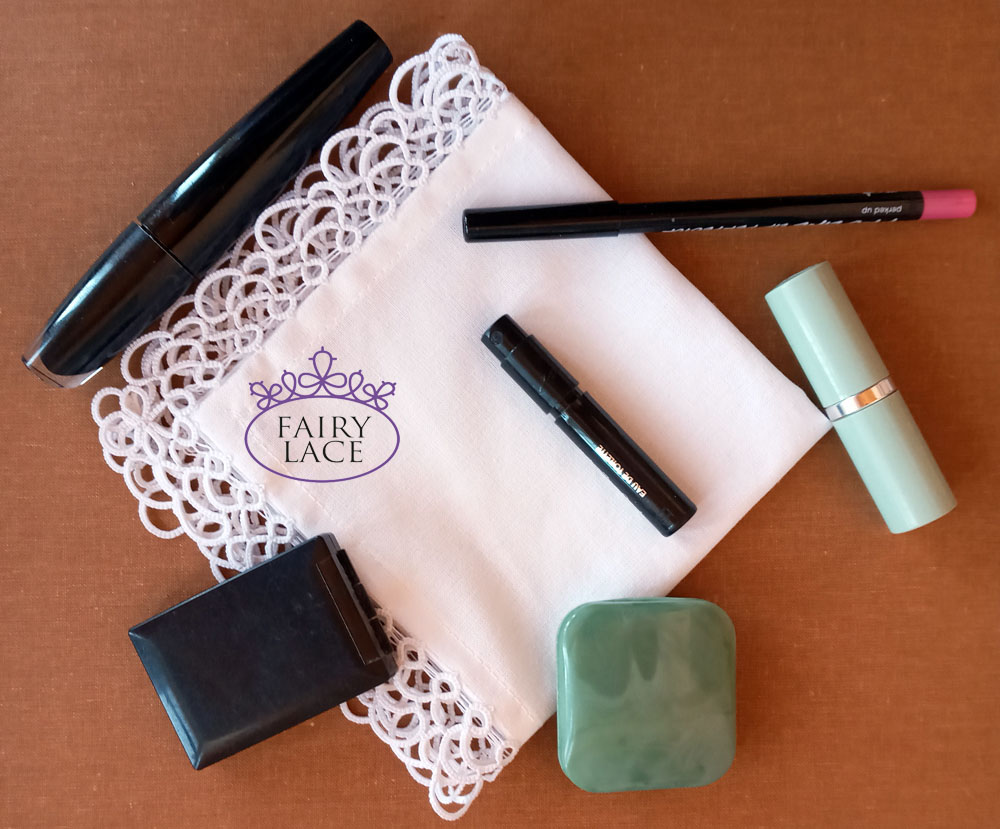
Flat lay of cosmetics and lace handkerchief by FairyLacefromElena on terracotta background

Must-have lady’s makeup bag , or why a handkerchief in a cosmetic bag.

Hello, everyone!

In this post I want to talk about the manners of a real lady. Of course, I understand that during the quarantine, our movements are limited. It should be so, no doubt But even on those rare days when we leave the house wearing masks, we want to look beautiful. Do you agree? My great-grandmother used to say: a real lady can never look unkempt. Of course, you will not paint your face, for example, in a supermarket or restaurant. I’m sure you do it at home. Same as me. But sometimes we have to fix our makeup. Therefore, I always carry a cosmetic bag in my purse. And in my cosmetic bag I put the necessary minimum of cosmetics. Because if I put together a complete set, I have to carry a huge suitcase!

So what do I put in my cosmetic bag.

This is a lip pencil, lipstick, mascara, eyeshadow, powder with a mirror, a small bottle of perfume and a handkerchief. Probably your set is different from mine. Or they are similar. But do you have a beautiful handkerchief? I’m not talking about compact packages of disposable antiseptic wipes. Because we have this subject all the time. In the car or in your pocket. Yes? But I feel like a real lady when I take out a thin lace handkerchief. Ah, those lace accessories. Ladies at balls dropped them at the feet of their gentlemen, hiding a note in a fabric. And what conflict arose between the musketeers over a silk handkerchief? Have you read Dumas’ novel The Three Musketeers?

How to sew tatting lace to fabric

I don’t throw a handkerchief on the floor or hide notes in there, ha ha! But I can laugh to tears. Yes, I am a very emotional lady. In this case, my makeup is slightly disturbed. And the contents of the bag will help me! I will gently and delicately remove the tears from my eyes with a handkerchief. And I like it if my handkerchief makes the ladies around me envy. So I make my handkerchiefs myself. Everything is very simple. I need to weave lace, sew this lace to the fabric. And voila, you’re done! Try it too! I’m sure you will like it! Moreover, I have prepared for you a new edging pattern and a video tutorial on how to sew tatting lace to fabric. The video contains three methods. Therefore, you can choose whichever one you like.

You can read more about the pattern here: https://fairylace.kozinenko.com/product/edging-pattern-fluffy-clouds/

And this is a link to a video tutorial, welcome: https://www.youtube.com/watch?v=akpnypHDdW8&list=UU3dn4_9pp7tIKA2k564wLBQ

I will be glad if you write in the comments what lies in your cosmetic bag. And also leave feedback on my new pattern and video, please. Subscribe to stay informed. Thanks!