Posted on Leave a comment

Cro-tatting Lesson 4

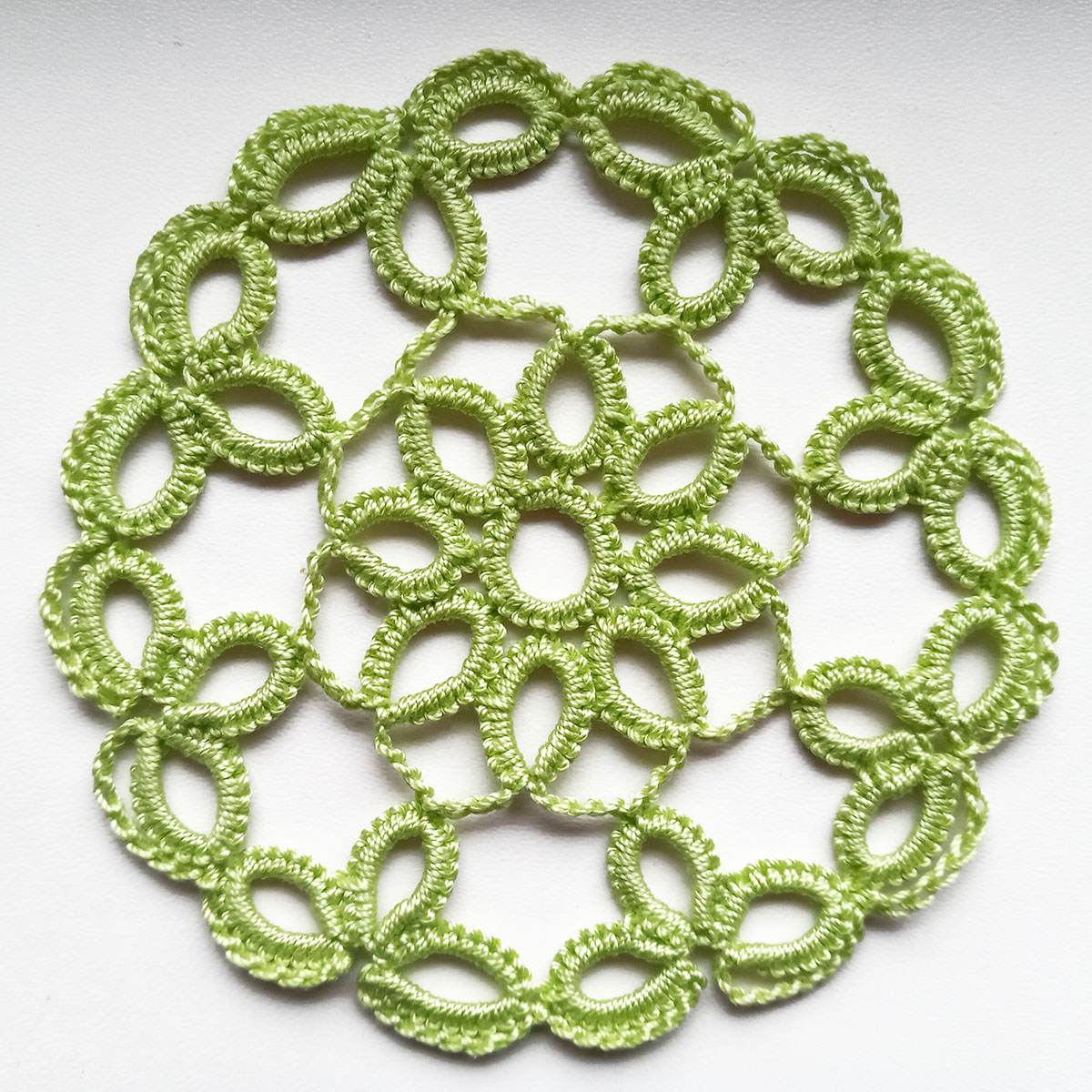
Green lace round coasters in cro-tatting technique.

Cro-tatting Lesson 4 , or how to make a split chain in cro-tatting technique.

Hello everyone! This article is a continuation of Lesson 3 . Therefore, follow the link if you have not read or watched the video of the previous lesson: https://fairylace.kozinenko.com/cro-tatting-lesson-3/

Ah, I tried my best in the previous lesson! I sought to convince all my readers of the need to master the reception of the split ring. By the way, this is necessary not only for cro-tatting, but also for the tatting shuttle and for the tatting needle. I hope many tatters will “follow me” in this matter, haha! And today I want to suggest that you use a split chain too as often as possible as well. But alas, I have no new arguments. I’m just sure that we must develop, improve and look for new ways and methods. Do you agree with me? Then you will benefit from my new video, I hope.

I use two methods to perform a split chain.

First method

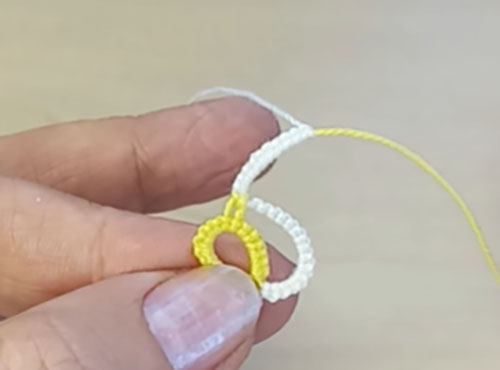
So, fhe first method is good when you move from row to row through chains. You hide the tail of the thread at the beginning of work and, as the second part of the split chain, perform a double crochet. The number of yarn overs should be 1 less than the number of loops in the first half of the split chain. In my video, this is 5sc and Triple Treble Crochet ( or Double Treble Crochet ). Here again I ask for your help. How is this element correctly indicated in English. Write to me in the comments, please.

Second method

But the second method is ideal if you are going to the next row through a split chain + split ring combination. So, in the video, you will see two threads after the split chain is completed. First thread – ball, and the second – long tail of the thread, which I left at the beginning of work. Therefore we can use these two threads to make a split ring.

Wow! I can imagine how tired you are of reading this! Of course, it’s better to watch the video. Don’t forget to leave a comment and subscribe to my YouTube channel! https://www.youtube.com/watch?v=OvR8NaB1-c4&list=UULF3dn4_9pp7tIKA2k564wLBQ
Posted on 2 Comments

Work on bugs

Illustrative video FairyLacefromElena how to fix a mistake in the picot connection

Work on bugs, or never fall into despair.

Hello everyone! Today I want to thank everyone who thinks of me, prays for my country and supports us in this terrible time. So I just can’t imagine how one can cope with depression or despair alone.

Yesterday I had a psychologically very difficult day. 400th day of open occupation, bombing and destruction of my country. Yes, my nerves can not stand it, alas. Although I try to do my favorite thing – tatting. But this is impossible. After all, creativity requires a special state of mind. Do you agree?

Ah, I had to reach out to FB tatting group members for support and prayers. My dears! I am extremely touched by your words and prayers. Also I low bow to everyone for not letting me fall into despair!

Fixing the bug connecting picots

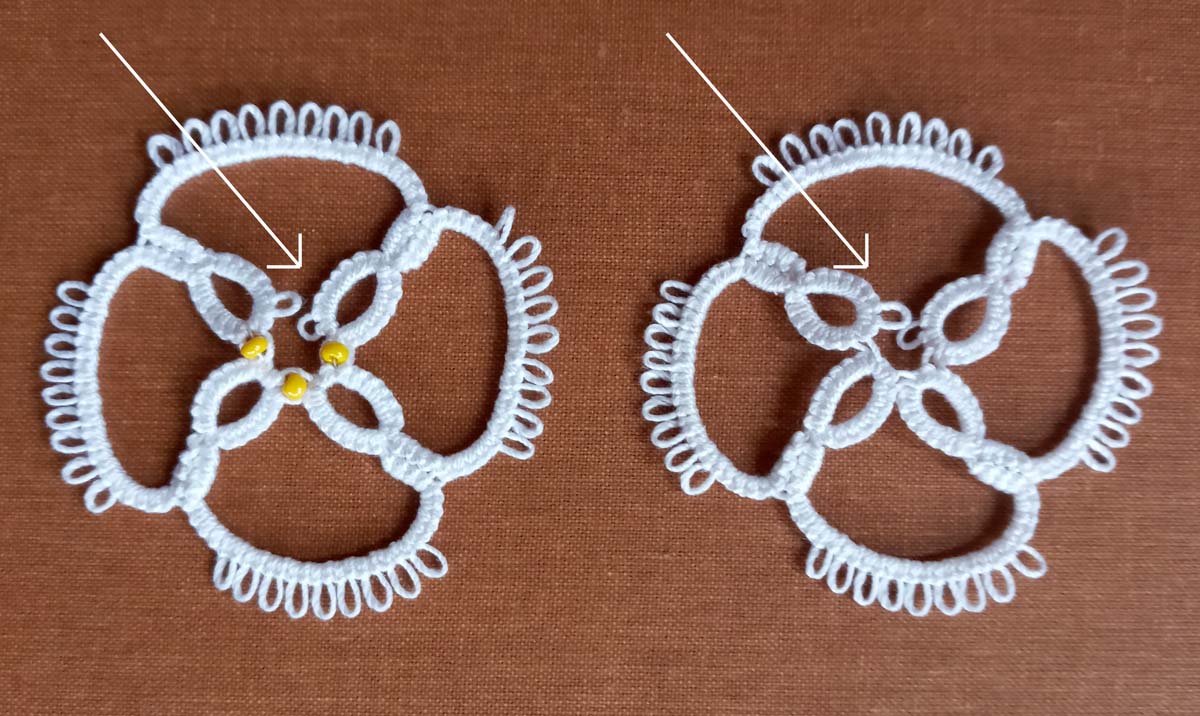
Unfortunately, circumstances do not always give me the opportunity to be an active participant in social networks. But I’m trying! Recently I saw a post with a photo of an error in the finished tatting product and the question is whether it can be fixed. Of cource, all needleworkers know how much time, work, focus and diligence we put into each of our handmade products. And then, finally, when you can with delight say “tadaaam!” , you discover an unfortunate mistake. Ah, I forgot to connect the two elements with picots according to the scheme. What to do? How to fix? Throw everything away and start over? Well, how can you not fall into despair.

But my article today is titled: Work on bugs, or never fall into despair. So, the main thing is not to succumb to negative emotions. As you know, there are two ways out of any situation, one of which is correct, ha ha! So what can we do? First, you can throw away this work and do it all over again. But that would be just the wrong way out. Therefore, I suggest taking a sewing needle and a thin thread of the same color as our product. This way you simply sew each missing picot to the ring (or chain, if it fits the pattern). Of course, it is difficult to explain this process in words. However, we have an assistant – YouTube channel! My new video on this topic is ready to watch, welcome! https://www.youtube.com/watch?v=2waGQ_elnk8&list=UULF3dn4_9pp7tIKA2k564wLBQ
Please subscribe to my blog, comment and share on social networks. And also check my store: https://fairylace.kozinenko.com/

Thank you!

Posted on Leave a comment

To do or not to do, that is the question

Red tatting bracelet with white beads

To do or not to do, that is the question! Or again about the front and back sides of tatting.

Hello, everyone! Today I want to touch again on the topic of front and back side of tatting. Ah, don’t get angry and don’t throw slippers at me! This dispute reminded me of the dispute between midgets from the novel by Jonathan Swift. On which side should the egg be cracked? I don’t think it matters. Because it is important to get to the delicious middle! Of course, every tatter is free to do as you like. But how I always want to get a “delicious”, beautiful, tender and perfect result!

I personally prefer to always distinguish between the front and back of my work. It’s probably a habit. This is especially true when you need to connect rows of different colors. I am sure you will agree with me, because if the connection is wrong, the product may not look very beautiful. But we strive for perfection, don’t we?

By the way, I was inspired to write this post by my new pattern, in which I connect the rows of white and red: https://fairylace.kozinenko.com/product/fish-heart-tatting-pattern/

To do or not to do the front and back sides of tatting

So, look closely at the photo.

In the first case, the connection is correct. Light threads do not peek out between the green ones.

And in the second case, the light thread is a small strip between the green ones.

But sometimes, you may need just such “wrong” strokes. After all, the fantasy of tatters is limitless and who knows what else we can come up with! So, decide for yourself, to do or not to do the front or back side of tatting! And as another argument, watch my video, please. Subscribe to my YouTube channel and follow my blog, welcome! https://www.youtube.com/watch?v=98FYbzTfzZE&list=UU3dn4_9pp7tIKA2k564wLBQ

Posted on 2 Comments

The perfect start to two-tone lace

Perfect start for two tone lace

The perfect start to two-tone lace, or how to hide the threads at the beginning of work.

Hello, everyone! In today’s post, I want to tell you how I hide the threads at the beginning of working with two colors.

I’m sure you all know that in the beginning we may have several options. It all depends on the pattern, of course! With a product of one color, everything is simple. This is either a shuttle – a ball, or two shuttles. Although there may actually be three, four shuttles or more, I’ve tried it! But let’s not delve into the impenetrable forest, ha ha!

If we start working with threads of two colors, we usually tie two threads.

Perhaps, if the threads are very thin, this initial knot is almost invisible. But I know about him! Ah, my perfectionism does not let me get bored! At the end of the work, I tried to untie this connecting knot in order to tie, hide and cut two pairs of threads. So instead of three nodes, I got only two. But I didn’t like that either. In addition, hiding FOUR ends of a thread at once is not for me, I sooooooo really don’t like hiding threads. But of course you will not find “tails” of threads sticking out in all directions anywhere in my products, lol! Because I love the option when the threads are hidden during the weaving process. By the way, you can watch my video on this topic.

I made this video for three tatting methods: shuttle, needle and cro-tatting. I hope you come back here after watching this video and read the post to the end: https://www.youtube.com/watch?v=K_fWxN3THBc&list=UU3dn4_9pp7tIKA2k564wLBQ&index=26

Ah, Mozart’s music is perfect for creating creative projects, isn’t it? Please write in the comments if you are hiding threads during work or only after the completion of the project.

But I’m a little distracted. Our theme is how to make the perfect start to two-tone lace. So, I don’t do the connecting knot at the start. I also hide both tails of the threads at once. At the end of the work, I connect the last element to the beginning with a crochet hook or needle. And in the end, I only have two tails of threads at the end of the work, which I hide with a sewing needle. Voila!

I showed the beginning of the process of weaving a tatting in two colors in my new video, welcome!
I will be glad to new subscribers, your questions and comments. https://www.youtube.com/watch?v=oZkXevylGAc&list=UU3dn4_9pp7tIKA2k564wLBQ&index=1


Also don’t forget to visit my store:

https://fairylace.kozinenko.com/product-category/patterns-tutorials/patterns-and-tutorials/

Posted on 18 Comments

How to stiffen tatting lace

How to stiffen tatting lace

How to stiffen tatting lace, everything I found on the internet and my personal experience. But I would sooooo much like to see your comments on my posts. Trust me, feedback is very important. After all, this is the only way I can understand how interesting my articles are. I am very interested to know if my experience was helpful to someone. So subscribe to my blog. Comment and ask questions. I will be happy to help with tips!

 Hello everyone! Thank you, dear friends, for new subscriptions. Your support helps me improve my blog and store!

Please be patient. Because the article will be too long. But I added pictures for fun! So, let’s begin! As beautiful as the pattern is, the finished tatting product almost always needs to be fixed. I mean giving stiffness and stability to the lace. All tatters know if the lace is not fixed, it looks sloppy. But we should always strive for excellence. Do you agree?

Apart from my own experience, I have found many articles on the Internet on this topic. There are many solutions. Among which are absolutely unexpected, ha ha! It turns out that you can make the lace stiffer: sugar syrup, starch, hairspray, nail polish, PVA glue, varnish for resin, embroidery fixing agent, and even candle wax. I’ve seen a few more experiments. But they did not interest me. So let’s talk a little more about each method.

Sugar syrup for to stiffen tatting lace

I don’t like using sugar syrup. It’s hot and uncomfortable. In addition, sugar lures pests who will eat delicious lace with pleasure!

Starch for to stiffen tatting lace

You can use the powdered kind that is dissolved in water. You will have to get the object totally wet with the starch and then pressed with a hot iron.

Or you can use the pressurized starch sprays that are available in the laundry section. There is a drawback to this method though. It isn’t recommended to use starch for white objects as it will yellow over time.

Hairspray for to stiffen tatting lace

It is interesting to experiment with hairspray. I have tried spraying a strong hold polish on the earrings. But after a few days the varnish peeled off. Therefore, the earrings lost their rigidity and shine, alas. But this method works well with pieces for greeting cards or framed pieces. Moreover, you can use glitter polish. This is what you need for Christmas!

Nail polish for to stiffen tatting lace

I have not tried using clear nail polish. But maybe you tried it? Then share your experience with us in the comments, please.

PVA glue for to stiffen tatting lace

is great for doilies and center pieces. Mix the glue with water. The proportions may vary. If you use a lot of glue, the solution will be too thick. You may be disappointed with the thin film on the back of the product. So the glue is absolutely not suitable for colored threads, only for light ones (white, ivory, etc.). And I think you should not use glue for the products to wear. These are collars, chokers, jewelry, clothing. So I don’t really like this method. And don’t forget! Do not iron! It will darken if you stroke it.

Varnish for resin


I did an experiment with varnish for resin. But the result did not make me very happy. Because I got insufficient rigidity of the earrings. you can also notice traces of dried varnish on the leaf on the right. I think that in this case it is better to use the tatting in resin method. I wrote about this in detail in my previous posts.

Spray for securing embroidery


I don’t use this for tatting. In my opinion, these funds are too expensive. And sooooo expensive for big projects. And also scares me DANGER: Extremely flammable. Fumes are harmful. Content under pressure. Keep out of reach of children.

Embroidery stabilizer solution


This is my favorite way. Read more about this in my article here: https://fairylace.kozinenko.com/cute-tatting-ring-final/

This is how I dispose of the remains of the embroidery stabilizers. I also like that these materials are harmless and environmentally friendly.

Candle wax for to stiffen tatting lace


This is a completely unexpected way for me! I was very surprised. Read more about this on the JEDDAH MOM blog. But come back to me at once! My story is not over. We continue! https://www.jeddahmom.com/how-to-stiffen-a-doily-with-candle-wax-2/

How to soak the finished product for to stiffen tatting lace

I have seen many videos showing the complete immersion of a small piece of tatting into a container of solution. Perhaps this works for small items. Provided that there are no long picots in the lace. Ha! Have you tried this trick on a large item? I tried it once. Now you can cry with me. For I have hopelessly ruined my long work on the bag. The lace should NOT be deformed during the application of the solution.

Therefore, I do not put tatting into the solution. On the contrary, I put the tatting on a flat surface and saturate with the solution. Of course, it is convenient to use a brush for small items.

It is very convenient to work with a spray. But in this case, some of the solution will not get on the product. And be sure to blot the wet product with a towel to remove excess solution.

I use a simple and “reliable” product – a cotton ball. With this ball, I can spread the picot out during the soaking process. I often don’t even need to use needles.

Where to place tatting lace for stiffen

It all depends on the size of the finished product. For example, earrings, snowflakes, bells can be placed on a table or windowsill. In any case, find a place where they will not interfere with you while drying. There are two important points. Try to keep out the sun and dust! To do this, cover the damp item with a plastic container and a towel. I do this for tatting in resin too.

But I have to place very large projects on the floor. When I was finishing the borders for the table linen set, my family was uncomfortable for a while. By the way, do not forget to lay polyethylene or oilcloth under your product BEFORE applying the solution.

And one more important question. Do you use needles for fixation? I don’t have a definite answer here. Because it all depends on the pattern. Of course, you cannot do without needles if there are long picots in the pattern. Or in cases where you need to achieve the perfect shape. For example, for a box.

Thanks for reading my opus! Perhaps I didn’t remember everything. You probably know other methods like to stiffen tatting lace. Then write about it in the comments, please. Your experience is very valuable!

Posted on 6 Comments

Measuring sticks or picot gauge

White tatting lace doily fragment with long picots of various lengths on black background, handmade by #FairyLacefromElena

Measuring sticks or picot gauge. How to make neat long picots. What tool is better to use for this.

Hello everyone! In early autumn, I finished creating my Summer Mood collection. After the blog post, many readers asked me which measuring sticks for long picots I used. Therefore, I decided to talk in detail on this topic. So, measuring sticks or picot gauge. I will share my experience and my opinion. Your opinion may be different, of course. Therefore, I ask you to share your opinion in the comments, please.

First, by tradition, I must start with history. But I don’t want to waste your time on long historical sentences. It is absolutely clear to me that tatting measuring sticks have been used for a long time. The next photo confirms this.

Photo signed: Antique bone tatting spatulas.

Very interesting, measuring sticks were called spatulas ?!

There are a wide variety of picot tools out there these days.

There is a variant of combining gauge for tatting needles and picots . I don’t like this kind of tool. In my opinion, it is too uncomfortable and cumbersome for weaving picot. Possibly just for measurement.

In my opinion, such sets are much more convenient. But these sticks are handy for tatting shuttles. For tatting with a needle, the wide ends get in the way. Anyway, for me.

The ideal option is straight plastic sticks of different widths. I found this picture on the Internet.

My measuring sticks for long picot

When I bought a set of mesh needles, I was very happy. Because this set includes three plastic sticks. They are long enough, smooth, comfortable. But only three sizes. And the package went sooooo long. And I need a lot of picot gauge of different sizes and urgently! To you too?

For example, to create this collar, I used 10 strips of different widths.

I took thick cardboard and cut out 10 strips of the desired width. The length of the stripes is whatever is convenient for you. I have signed a number on each strip. This number indicates the width of the strip in millimeters. Then I covered each strip with scotch tape for better glide. This method is perfect! You can make as many measuring sticks as you like, quickly and easily. Is not it?

Another option is to make spatulas (haha) from used plastic cards. But you have to try, because cutting such a card neatly and neatly is not very easy. But you get a graceful, smooth and durable strip.

Also, I don’t throw away ANY plastic sticks. For example, ice cream sticks. It’s a shame they only have one size.

Helpful advice for use measuring sticks

Pay attention to how the measuring stick is positioned during weaving. The strip can be parallel or perpendicular to the work. This will determine how long the picot will turn out in the finished form.

For example, in this photo, the cardboard strip is located perpendicular to the work. The shuttle and ball threads are located on both sides of the strip. Therefore, in the finished form, the picot will turn out to be two times shorter (in this version, 7, 5 millimeters). By the way, this method is suitable for weaving only one picot at a time.

But if you want to make several picots in a row, you need to position the stick perpendicularly. And in this case, the finished picots will be the same length as the measuring stick is wide.

The same applies to tatting with a needle.

I invite you to check out my pattern patterns using long picots. I hope you will enjoy. Especially, off 10% for you! Coupon code OFF10HAPPYPATTERN is valid until December 31st. Welcome! https://fairylace.kozinenko.com/product-category/patterns-tutorials/patterns-and-tutorials/

I also hope my video will be interesting and useful to you. https://www.youtube.com/watch?v=Of-fmKKNp4A&list=UU3dn4_9pp7tIKA2k564wLBQ

Subscribe to my blog, comment, ask questions. I will be happy to help.

Posted on 4 Comments

Long picots

Green, red, and white tatting lace bells with long picots and beads hanging on a pine branch, handmade by #FairyLacefromElena

How to make straight long picots.

Hello everyone! First, I want to thank everyone for your prayers and support. My husband is doing better. The new cardiogram showed only one systole. My dear hubby will have another checkup next week. And I hope everything will be fine.

And now about something even more pleasant. 🙂 I have already written in previous posts about my hobby for long picots. Yes, I created a new collection based on this method. This is Summer mood. https://fairylace.kozinenko.com/product/summer-mood-collection/

So, you asked what picot gauge I use. You can take a “tatting needle and picot gauge”. But I do not like bulky tools. I use plastic strips of different widths or homemade cardboard templates. Because you can make them as many as you like, any width and length! https://fairylace.kozinenko.com/2019/10/22/additional-tools-for-tatting/

Also, I needed 10 strips of different widths to make the collar necklace “Sea Glass”! https://fairylace.kozinenko.com/product/sea-glass-tatting-pattern/

Detachable blue collar necklace for Dress Sia Glass

I’m putting together a collection of platinum stripes! Because I like long gauge. After all, this is very convenient for weaving several picots in a row. But this is in my opinion, of course. I made a video for you how to make even long picots. And of course I show 4 ways.

First

Tatting with a shuttle.

Second

Tatting with a needle.

The third

Cro-tatting.

The fourth

This my favorite tatting tool – the netting needle. Don’t forget to come back to me after watching the video, please! https://www.youtube.com/watch?v=Of-fmKKNp4A&t=20s

I hope you enjoy tat the long picots. It’s so exciting, isn’t it? In addition, I always call for the expansion of knowledge and skills. My great-grandfather used to say: to know and be able to – not to carry, but in life it will come in handy. Oh, sorry, I don’t know the English equivalent of this proverb!
Here is another pattern with long picots. This cute Christmas bell is easy to make just by following the instructions! Welcome! https://fairylace.kozinenko.com/product/christmas-bell-pattern/

Subscribe to my blog. Comment and ask questions. I will be happy to help with tips!

Posted on Leave a comment

Tatting curl

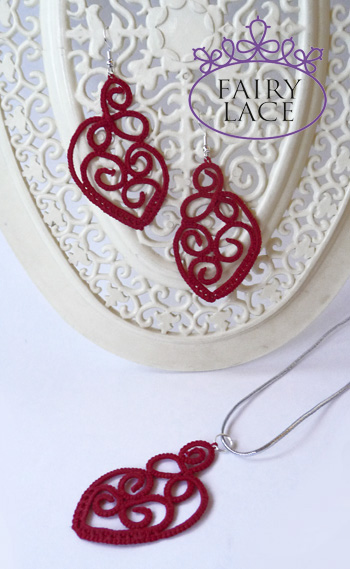
Red tatting earrings and pendant in heart shape on white background, made with the curl element by FairyLacefromElena

Tatting curl. How to make curl in beginning work.

Hello everyone! I recently made a new pattern for tatting earrings ” Valentine “. By the way, now you can buy any pattern at a discount 10%. Use coupon code: OFF10HAPPYPATTERN

https://fairylace.kozinenko.com/product-category/patterns-tutorials/patterns-and-tutorials/

Tatting curl

I used curl in these earrings. After posting to the FB, you asked me how to do this.

So I decided to tell you more about how I make curls. There are several subtleties. Take my advice. And then your curls will look perfect!

First trick

You must try to ensure that all nodes are strong enough. Do you know that you can determine the nature of a person by nodes? Yes, psychologists know many tricks to analyze us! If your nodes are very strong, you have a solid and even somewhat tough character. If you make free knots, then most likely your character is soft and calm. Please write in the comments if your nodes match your character! It is very interesting. Because my nodes even depend on my mood, yes! Oh, I’m a little distracted! So, tatting curl. What you need for a perfect curl. Firstly, try to make your nature very solid at this moment 🙂 The stronger the knots you tie, the better it a curl will hold the form.

Second trick

We start tat with a chain sometimes. Of course, it depends on the pattern. In this case, it is convenient to use a paper clip. But for curl, this does not work absolutely. Because you get a weak knot at the beginning of the curl after disconnecting the paper clip. What to do? I take a small piece of thread. How it works, check out my video. This my video shows three methods of tatting, as usual: tatting with a shuttle, tatting with a needle and cro-tatting. You can easily and simply make a curl at the beginning of weaving. https://www.youtube.com/watch?v=P0zrZP-a6dQ


Subscribe to my blog. Comment and ask questions. I will be happy to help with tips! Welcome!  https://fairylace.kozinenko.com/blog/

Posted on Leave a comment

Hiding end threads in tatting

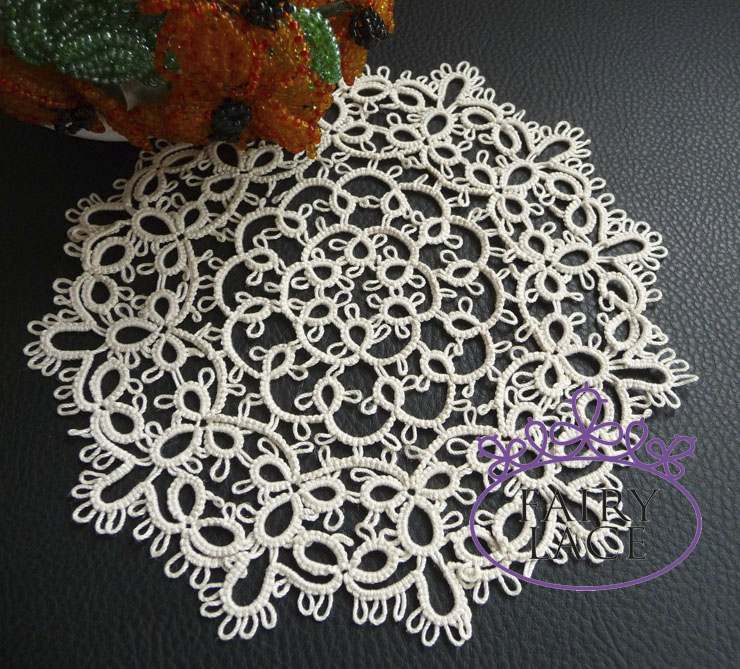
Fragment of lace tatting round doily

Hiding end threads in tatting.

Oh, I already wrote before that I don’t like to hide the ends of threads. Does any of you love this? How terrible it is: to remove a lot of cut ends, worrying so that they do not come apart. Many tatters come up with how to make this process easier. Beginner tatters master the classical methods. In any case, it was so with me. Here you can watch my video, which shows in detail how I did it before. https://www.youtube.com/watch?v=HKBg6xUGZL8&t=939s

I have studied many textbooks and videos on the Internet over ten years of my practice of tatting. Of course, there are many interesting and useful master classes for hiding end threads in tatting. But I did not find any material that combines the three methods of tatting: shuttle, needle and hook. My goal is to promote all kinds of tatting. Therefore I hope you will be interested in my experience!

So, a short review of today’s video. I like make large laced items, such as doily, tablecloths, collars, etc. In this case, I will have to “lengthen” the thread several times. And should try to make the snapping of the thread invisible and durable. After all, it is very important from an aesthetic and practical point of view! If I hide both cut ends in one ring or one chain, I get a thickening. (I don’t even consider the option with four threads at once!) Therefore, it is better to tie a new thread at the junction of two or more elements. Example in the photo.

Hiding end threads in tatting

You can modify and improve my experience, of course. I will be glad if you share in the comments your ways of hiding end threads in tatting. Welcome! https://youtu.be/K_fWxN3THBc

By the way, in conclusion, I want to say sorry-sorry-sorry-sorry! I forgot to activate the payment button for all countries. now this mistake is fixed. So I am extending the term of the action with a 10% discount on all my patterns. Now the PATTERNXMASDECOR coupon is valid until December 15th! Take advantage! https://fairylace.kozinenko.com/product-category/patterns-tutorials/

Subscribe to my blog. Comment and ask questions. I will be happy to help with tips!

Posted on Leave a comment

Tatting split chain

Round nude tatting doily with split chain pattern, styled with red rose by FairyLacefromElena

Tatting, split chain, new video tutorial.
I already wrote that I really don’t like to hide threads in tat (and nobody likes, right? 🙂 Therefore, I try to do tatting without cutting the thread between the rows. In one of my past posts, I showed you how to go from row to row using an split ring. https://fairylace.kozinenko.com/2019/10/15/video-lesson-for-three-types-of-tatting/
Today’s post is very short. I don’t want to take your time to read, because you can better watch a video with wonderful music like Mozart! So today, my new video. This a tatting lesson on how to make a split chain. As usual, I show all three types of tatting: shuttle tatting , needle tatting and cro-tatting. Perhaps for needle tatters this video will be especially interesting. Because for a tatting needle, there are two methods to make a split chain. So, welcome to my YouTube channel: https://youtu.be/qkj3_N7LBaE

Tatting. Split chain_Moment

Subscribe to my blog , who is interested in tatting in resin! Because several articles on this topic are waiting for readers of my blog very soon. I will share ALL the secrets that I know myself 🙂 And of course, I’m sure these articles will help you make transparent tatting in resin absolutely perfect!

Welcome to my store:

https://fairylace.kozinenko.com/product-category/patterns-tutorials/
 I like reading your comments, thanks! Comment and ask questions. I will be happy to help with tips!